Notes to self. (The thinking process whilst making).
Dot in the landscape no longer.
What are you trying to say?
Do you want to say anything?
Do you need to say anything?
Personal to me. Irrelevant to others?
How connect to others? Do I need to?
No excuses.
Travel. Journeys. Real. Metaphorically.
Invisible Line. Real Line.
Thoughts in Space. Me in Space.
Ruins - but not ruins at all.
Ephemera.
Dots as written language.
Like circles. Untouched & ½ touched.
Mathematical. Not.
Mechanical. The Handmade.
Flaws. Want them.
Joined. Not joined.
Touching. Spaced apart.
Rows. Random.
More than one large circle (not just the one).
The edge of the paper. Problematic.
Infinite space. Just a part of.
Splitting.
I can barely see what I am doing.
Invisible drawing.
I drive 25 miles or so to draw nothing.
No. Crap.
Thinking maps, distances, travel, text.
Want to write something in pictorial code.
Worlds. Islands. Rain. Mismatched circles. Wallpaper. Plotting.
Can't write. Want to write. Don't know what to say? What am I trying to say? Nothing. Want to get something out.
The edges (are) holding back the work. Pinned whole paper. Had to get it down. An urgency. Out.
What is it with me and language? Text and struggle with pictorial text?
The whole paper pinned. What?
It definitely felt like writing. A message. I don't understand.
(Words) Makes the work too defined?
Maybe its about time.
Get familiar with your materials. Feel them. Be in tune with them.
Skin.
Time.
Pummeling into the dots. Needs force, but controlled. Work with the paper. Try to understand it.
Too much force tears the paper. Machine gun approach doesn't work - that's the easy option.
The piercing into the paper disrupts the rhythm.
The edge of the paper still bothers me. Too straight. A boundary.
The holes/tears bother me. Have pierced into the surface/broken it.
Still like invisible drawing 'cause working on reverse side.
A void, an opening, a slit, a door?...
Wrinkles - a skin. A surface.
Letting in or letting out?
A passageway.
Embossing ⟷ Pinning
Tissue paper wrinkles.
Cellotape wrinkles.
Imprint dots.
Tracing paper dots.
Relationship between ② & ③ ?
Adding/removing.
The mix of black (to make black).
2D plane & 3D plane.
'painted' surface - graphite sheen, charcoal matt, emboss leather.
What works; what doesn't.
Is it the dots or the colour of the dots?
Need to choose what colours I want to work with (how?)
What colours to match up to e.g. am I trying to make a chocolate brown or a skin colour?
An exact or an imagination
Colour is giving me too much choice. Becomes muddly.
Need to set parameters / instruction. Simple yet effective.
Holes or dots?
When you punch holes in what colour do you put behind?
(Colour)
Too bigger jump? Why. In what context? Doesn't make sense i.e. its wrong. Too radical. Doesn't add up. How does this relate to anything? To me. Is it a cry for help in the creative 'wrong' sense?
So many combos of colours - way to go, as in choices. Too complicated. Simplify it or move on.
I know I enjoyed mixing the colours (visually and practically) but then what.
Pinning tracing paper = new needle = pricking noise (click). Edgy as pin pierces the surface. You can feel it.
Shading ✗ or ✓ ?
Like an image forming of it's own accord. Yet should I think more carefully about it?
Should the process be seen as well in the work. Directly? Or should it be more subtle?
Sunday, 12 June 2011
Sunday, 5 June 2011
Blog 13
I have been in the studio for two weeks now and settling in to the art of making again. Properly. No grabbed moments aware of upsetting the harmony in our small shared space that is the van. Renting studio space has given me much more structure and discipline and a proper sense of purpose again to the business of making art.
The studio is probably the best studio I have ever worked in. It is large, spacious, with one wall of windows, which lets in a wonderful amount of light. It is tidy yet grubby, and full of interesting furniture and paraphernalia for making arts and crafts. But I can move around it freely, able to work independently as I wish. It is also very quiet with the occasional sound of music coming from the next door music room. I've never settled in other studios before. Am I ready for this now, or were the other studios just not right for me?
The main objectives for being in a studio space is the act of making work again, and hopefully some finished pieces. I would like to sell some work but as importantly, I want to mix with other people and be part of a creative environment again.
It is very encouraging for me to see that the type of exhibitions held at this arts centre not only include selling shows, but also they present installations, video art, films and photography. I have a constant internal battle between thinking I should make only work to sell verses wanting to make work that isn't necessarily sellable but still worthy and valuable in the non pound (£) sense. I am developing a great rapport with the arts officer, which will give me an insight into her job role and the running of an arts centre and also the organisation of exhibition programmes and how artists and curators are selected.
There is this idea between perfecting what you know how to make and pushing it further, verses trying out new techniques, materials and processes. I am still embossing (pressing into paper with an inkless pen) and pinning (punching holes into paper with a pin). Two slightly different methods yet somehow connected. It is a methodical process, quite tense yet random, physical, making my right arm ache and my fingers go numb. It is what I know and what I've been 'obsessed' by, particularly the pinning.
With the pinning, there is the sense that I am trying to write something down, a kind of pictorial calligraphic text. With the embossing, I am playing with the paper more as a material, altering it's structural state.
I have been reading Writings 1968 - 2008 by artist Giuseppe Penone. He writes as he makes, trying to understand his art making in context with his practice. His artwork and texts marry together. As I am somebody who wants to keep writing, I am trying to find a way to join my writing with my art making. I have started a small sketchbook which sits next to me whilst I am making and I write notes and draw sketches as I work. This methodology is going quite well at the moment, with a much more cohesive flow to my thoughts, texts and processes, rather than the more random 'post-its' that I usually leave lying around elsewhere.
Giuseppe Penone works in the landscape located where he lives. He talks very much about the materiality of his sculptures, particularly wood, and how you must really get to know your material in order to understand it and what you are doing. I can feel myself trying to understand the paper I am working with much more.
In 2009 I presented my first canvas, having avoided the aspect of traditional painting throughout most of my art education. Using a square canvas I drew hundreds of black ink dots onto a graphite ground. I have briefly been looking at Lucio Fontana and his canvas slashes and thinking about the idea of pinning into canvas. I have also been looking at artist Vija Celmins who creates images of skies at night, endless white stars on a black background. She paints onto paper before working into the ground with charcoal or graphite adding or taking away the material layers.
I'm curious about painting but it seems a massive area to consider. I work in black or white only but am learning that black is made up of other colours mixed together. Perhaps I can have some 'play' time and experiment with mixing paint to make my own blacks as a beginning way to explore colour and consider a more painterly approach to my work. It may be a five minute wonder?
I'm enjoying myself, quite knackered. Frustrated, anxious, excited, calm, not calm, all the feelings of a enquiring artist. I've made a good start, being back in the studio.


The studio is probably the best studio I have ever worked in. It is large, spacious, with one wall of windows, which lets in a wonderful amount of light. It is tidy yet grubby, and full of interesting furniture and paraphernalia for making arts and crafts. But I can move around it freely, able to work independently as I wish. It is also very quiet with the occasional sound of music coming from the next door music room. I've never settled in other studios before. Am I ready for this now, or were the other studios just not right for me?
The main objectives for being in a studio space is the act of making work again, and hopefully some finished pieces. I would like to sell some work but as importantly, I want to mix with other people and be part of a creative environment again.
It is very encouraging for me to see that the type of exhibitions held at this arts centre not only include selling shows, but also they present installations, video art, films and photography. I have a constant internal battle between thinking I should make only work to sell verses wanting to make work that isn't necessarily sellable but still worthy and valuable in the non pound (£) sense. I am developing a great rapport with the arts officer, which will give me an insight into her job role and the running of an arts centre and also the organisation of exhibition programmes and how artists and curators are selected.
There is this idea between perfecting what you know how to make and pushing it further, verses trying out new techniques, materials and processes. I am still embossing (pressing into paper with an inkless pen) and pinning (punching holes into paper with a pin). Two slightly different methods yet somehow connected. It is a methodical process, quite tense yet random, physical, making my right arm ache and my fingers go numb. It is what I know and what I've been 'obsessed' by, particularly the pinning.
With the pinning, there is the sense that I am trying to write something down, a kind of pictorial calligraphic text. With the embossing, I am playing with the paper more as a material, altering it's structural state.
I have been reading Writings 1968 - 2008 by artist Giuseppe Penone. He writes as he makes, trying to understand his art making in context with his practice. His artwork and texts marry together. As I am somebody who wants to keep writing, I am trying to find a way to join my writing with my art making. I have started a small sketchbook which sits next to me whilst I am making and I write notes and draw sketches as I work. This methodology is going quite well at the moment, with a much more cohesive flow to my thoughts, texts and processes, rather than the more random 'post-its' that I usually leave lying around elsewhere.
Giuseppe Penone works in the landscape located where he lives. He talks very much about the materiality of his sculptures, particularly wood, and how you must really get to know your material in order to understand it and what you are doing. I can feel myself trying to understand the paper I am working with much more.
In 2009 I presented my first canvas, having avoided the aspect of traditional painting throughout most of my art education. Using a square canvas I drew hundreds of black ink dots onto a graphite ground. I have briefly been looking at Lucio Fontana and his canvas slashes and thinking about the idea of pinning into canvas. I have also been looking at artist Vija Celmins who creates images of skies at night, endless white stars on a black background. She paints onto paper before working into the ground with charcoal or graphite adding or taking away the material layers.
I'm curious about painting but it seems a massive area to consider. I work in black or white only but am learning that black is made up of other colours mixed together. Perhaps I can have some 'play' time and experiment with mixing paint to make my own blacks as a beginning way to explore colour and consider a more painterly approach to my work. It may be a five minute wonder?
I'm enjoying myself, quite knackered. Frustrated, anxious, excited, calm, not calm, all the feelings of a enquiring artist. I've made a good start, being back in the studio.

Snapshot from my phone. Embossing paper - detail.

Snapshot from my phone. Pinning paper - detail
I like the idea of altering the structure of the material. Sculpture on a two dimensional plane. There is the sense of a skin. I want to charcoal the paper which will give a velvety texture. Graphite will give a metallic look. What would happen if I use paint, as a ground, or a finished surface? Where does paint fit into this?
Saturday, 21 May 2011
Blog 12
We have finally made it to the Isle of Mull on the west coast of Scotland and returned to the world of work again, with it's daily routines, tick-lists, customer service and employee banter.
We are lucky, situated in a beautiful location right next to the sea with the Scottish hills beckoning us in the distance. Already we have seen two stag, an owl, a heron and an otter, without even having to leave the site.
Working long and irregular hours, we will have to make the most of any precious time when we can be together. Working again seems familiar, yet not familiar, having had a break for a year and a half.
I say 'we', but Shawn is the one actually earning the money, working on a campsite for the summer. For my part, I have arranged to have some studio time at the island's art centre in Tobermory to make some new artworks. I am also going to help the visual arts officer with gallery installations and other jobs at the centre. I hope to sell some art and very much looking forward to being part of a creative environment again.
We have always been grafters, often the first on site in the morning and the last to leave at night, dedicated, passionate and committed to the job in hand. With years of experience in different fields of industry between us, we have the flexibility of location and hours without the constraints of family and mortgages. This is an exciting time for us.
In the last couple of days I have read Alain de Botton's The Pleasures and Sorrows of Work. I've had the book for a while but couldn't pick it up until now. Why do we go to work? Besides money....
de Botton suggests that we work to give ourselves meaning to life and a reason to exist. At the least, work distracts us. Working helps to give us skills and worth, even if small. It is our identity.
Interestingly, de Botton comments on when you meet someone new, one always asks 'What do you do', as in what work do you do? In our society, people are evaluated by what work they do or don't do.
He writes extensively on how we have made the working world and the volume and importance of it so intense. We want 'stuff'. From clothes to furniture to gadgetry and exotic food. We fill our lives with objects and 'stuff'. These things need to be created, manufactured, costed, delivered, consumed. And we always want more. And we have to work in order to make them and then get them.
Then there is the subsections of primary, secondary and tertiary goods that are needed to make up a finished product, and the tools devised by designers and manufacturers to make the 'stuff'. And so it goes on.
And don't forget human resources jobs that support the work system, providing training, people skills and counselling for when your too stressed or depressed.
I make work sound bad. But it is not if you love your job, and I always did love working. I was a slave to the system. It was only through hard work, luck, and savings, that allowed us to take some time out.
Noticeably, de Botton doesn't cover vocational jobs like the caring profession or teachers, although there is one chapter on the job of an artist.
Entering the world of work again, it is going to be an interesting summer, full of new and old surprises. No doubt, people will say "welcome back to reality". We hope it will be a pleasurable experience.
And the money will be good.
We are lucky, situated in a beautiful location right next to the sea with the Scottish hills beckoning us in the distance. Already we have seen two stag, an owl, a heron and an otter, without even having to leave the site.
Working long and irregular hours, we will have to make the most of any precious time when we can be together. Working again seems familiar, yet not familiar, having had a break for a year and a half.
I say 'we', but Shawn is the one actually earning the money, working on a campsite for the summer. For my part, I have arranged to have some studio time at the island's art centre in Tobermory to make some new artworks. I am also going to help the visual arts officer with gallery installations and other jobs at the centre. I hope to sell some art and very much looking forward to being part of a creative environment again.
We have always been grafters, often the first on site in the morning and the last to leave at night, dedicated, passionate and committed to the job in hand. With years of experience in different fields of industry between us, we have the flexibility of location and hours without the constraints of family and mortgages. This is an exciting time for us.
In the last couple of days I have read Alain de Botton's The Pleasures and Sorrows of Work. I've had the book for a while but couldn't pick it up until now. Why do we go to work? Besides money....
de Botton suggests that we work to give ourselves meaning to life and a reason to exist. At the least, work distracts us. Working helps to give us skills and worth, even if small. It is our identity.
Interestingly, de Botton comments on when you meet someone new, one always asks 'What do you do', as in what work do you do? In our society, people are evaluated by what work they do or don't do.
He writes extensively on how we have made the working world and the volume and importance of it so intense. We want 'stuff'. From clothes to furniture to gadgetry and exotic food. We fill our lives with objects and 'stuff'. These things need to be created, manufactured, costed, delivered, consumed. And we always want more. And we have to work in order to make them and then get them.
Then there is the subsections of primary, secondary and tertiary goods that are needed to make up a finished product, and the tools devised by designers and manufacturers to make the 'stuff'. And so it goes on.
And don't forget human resources jobs that support the work system, providing training, people skills and counselling for when your too stressed or depressed.
I make work sound bad. But it is not if you love your job, and I always did love working. I was a slave to the system. It was only through hard work, luck, and savings, that allowed us to take some time out.
Noticeably, de Botton doesn't cover vocational jobs like the caring profession or teachers, although there is one chapter on the job of an artist.
Entering the world of work again, it is going to be an interesting summer, full of new and old surprises. No doubt, people will say "welcome back to reality". We hope it will be a pleasurable experience.
And the money will be good.
Monday, 25 April 2011
Blog 11
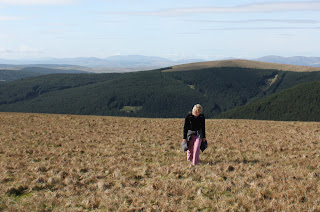
Yesterday we went on a walk. A full days walk, something we haven't done for a while. We followed the path of Andy Goldsworthy's Striding Arches. A set of three stone built curves set on the top of the hills in the Dumfries and Galloway area. A forth arch has been built inside to outside of an old disused farm building, our starting point.
I am a huge fan of Goldsworthy. He has played an influential part in my development as an artist and is a great inspiration to follow. Working directly in the landscape he makes sculptures, permanent and temporary, using the materials that he finds or that belong or are associated with a particular area. His work can have a performative edge or action that happens either straight away or over a long period of time, such as melting ice, plant decay, or ageing of wood or stone.
It was a strenuous walk, physical. My senses were heightened and I became very aware of all the colours around me. They seemed brighter than ever. Was this because Portugal had been drier and more arid? A hue of greens and greys with the occasional exotic plant. The ground in Scotland is lush, illuminous almost, with all shades of browns and oranges, pinks and greens all mixed in. I mainly work in monochrome, black and white, and these colours are bright.
It is also very noisy, not of dogs barking and the tinkling of the bells around the sheep, goats and cow's necks in Portugal, but of birds and insects. It seemed almost deafening. Lovely, but very loud. At least it seemed so.
It was good to be out in the fresh air. I seem to crave the sensation of wind blowing in my face, almost hungary, just for that. The sense of touch perhaps, and a metaphorical "blowing away the cobwebs", freedom.
We walked through the forest. 'Proper' forest, where the path disappeared and we had to scramble vertically up the hill side, through the trees, almost on our hands and knees, getting covered in all manner of pines, twigs and plant debris on the way. Initially I loved being in the forest, the soft carpet ground, the smells of the wood, the hushed silence, I suppose - the adventure, but I started to get anxious and panicked and the trees felt like they were closing in on me, claustrophobia. The young branches looked like a web spreading out above and around me. We finally made it out from the trees up onto open ground.
When I walk, it is for the experience of the walk and a place/time to think. Often I become oblivious to the views around me. Because there were so many ups and downs, and I hate going up hills, I focussed on Shawn's footsteps in front of me. If I couldn't see the hill in front of me and it's 'verticalness', then I could just keep walking, each step at a time, until I got to the top. Only then would I look around at the views and my surroundings. It's interesting that many of my drawings are like imaginary landscapes that you look down from above, yet when I am, in real life, at a high point looking down from above, I don't actually take it all in. I love the views, but I don't thrill about them. They're kind of just there, but obviously seem to be important in my drawings, as that is what I draw.
After seeing the first arch in the farm building, we managed to reach two more, the forth one being too far away. Able to sit next to the stone, they were a shelter and marker points for our journey. Pleased to be sharing in the work of Goldsworthy, I think I would have been more excited if I had discovered one of his ephemeral pieces somewhere, such as a pattern of leaves, or a drawing of twigs.
We were right out, almost on our own. There was a lack of humans, but not really. There was a wind farm ahead of us, an aeroplane flying high in the sky, and the odd bleeping of the mobile phone. Hey ho.
I do like walking, both as an exercise and activity. I have been part of three group walks led by Hamish Fulton, whose practice is all about the walk - "no walk, no work" he will say. It was a good walk yesterday and I know I ache a bit today!


I am a huge fan of Goldsworthy. He has played an influential part in my development as an artist and is a great inspiration to follow. Working directly in the landscape he makes sculptures, permanent and temporary, using the materials that he finds or that belong or are associated with a particular area. His work can have a performative edge or action that happens either straight away or over a long period of time, such as melting ice, plant decay, or ageing of wood or stone.
It was a strenuous walk, physical. My senses were heightened and I became very aware of all the colours around me. They seemed brighter than ever. Was this because Portugal had been drier and more arid? A hue of greens and greys with the occasional exotic plant. The ground in Scotland is lush, illuminous almost, with all shades of browns and oranges, pinks and greens all mixed in. I mainly work in monochrome, black and white, and these colours are bright.
It is also very noisy, not of dogs barking and the tinkling of the bells around the sheep, goats and cow's necks in Portugal, but of birds and insects. It seemed almost deafening. Lovely, but very loud. At least it seemed so.
It was good to be out in the fresh air. I seem to crave the sensation of wind blowing in my face, almost hungary, just for that. The sense of touch perhaps, and a metaphorical "blowing away the cobwebs", freedom.
We walked through the forest. 'Proper' forest, where the path disappeared and we had to scramble vertically up the hill side, through the trees, almost on our hands and knees, getting covered in all manner of pines, twigs and plant debris on the way. Initially I loved being in the forest, the soft carpet ground, the smells of the wood, the hushed silence, I suppose - the adventure, but I started to get anxious and panicked and the trees felt like they were closing in on me, claustrophobia. The young branches looked like a web spreading out above and around me. We finally made it out from the trees up onto open ground.
When I walk, it is for the experience of the walk and a place/time to think. Often I become oblivious to the views around me. Because there were so many ups and downs, and I hate going up hills, I focussed on Shawn's footsteps in front of me. If I couldn't see the hill in front of me and it's 'verticalness', then I could just keep walking, each step at a time, until I got to the top. Only then would I look around at the views and my surroundings. It's interesting that many of my drawings are like imaginary landscapes that you look down from above, yet when I am, in real life, at a high point looking down from above, I don't actually take it all in. I love the views, but I don't thrill about them. They're kind of just there, but obviously seem to be important in my drawings, as that is what I draw.
After seeing the first arch in the farm building, we managed to reach two more, the forth one being too far away. Able to sit next to the stone, they were a shelter and marker points for our journey. Pleased to be sharing in the work of Goldsworthy, I think I would have been more excited if I had discovered one of his ephemeral pieces somewhere, such as a pattern of leaves, or a drawing of twigs.
We were right out, almost on our own. There was a lack of humans, but not really. There was a wind farm ahead of us, an aeroplane flying high in the sky, and the odd bleeping of the mobile phone. Hey ho.
I do like walking, both as an exercise and activity. I have been part of three group walks led by Hamish Fulton, whose practice is all about the walk - "no walk, no work" he will say. It was a good walk yesterday and I know I ache a bit today!

Colt Hill Arch

Benbrack Arch with Colt Hill Arch in the distance

Walking up toward Colt Hill Arch
Monday, 18 April 2011
Blog 10
We have just travelled 1700 miles, driving through 5 countries in all. I have been in my pod, skimming the earth's surface. I could talk about particular sights we saw, but I am more interested in the experience of the journey, memories, feelings, emotional attachment and detachment.
I drifted along, in a kind of daze, a lot of the time. Sleeping, listening to music, both of us singing at the top of our voices, to relieve the momentous of the road in front of us. All sorts of thoughts and random discussions taking place, individually, silently, verbally. I don't like to read when I'm travelling, in case I might miss out on something. It also allows for a more free associative experience.
Due to longer daylight hours we were able to travel further before it got dark, shortening the overall time of travelling. It made me think about mathematical time and distance, verses actual time and distance. Complex.
Staying in motorway service stations most of the way through Europe, I felt like I was in a kind of no-man's land. We were a strange community of passer's-by, drifting through space. What was everyone's story - where had they come from and where were they going? Like the airport, this non-place seemed soulless, yet was actually full of life and activity.
Travelling through 5 countries means crossing a number of borders and I've been trying to get my head round the concept of land based borders and water based borders. In Europe you can pass from one country to another easily, whereas in the UK it is more difficult being an island surrounded by water. In Europe it can be spontaneous, whereas in the UK it involves some planning, to cross a border. Water can be a good defence mechanism etc. etc. but what effect does it have on the larger scale of human relationships? Individualism. Isolation. Inclusion.
Of course, memories, language, cultural differences, habitation etc. all come into play when you travel long distances. Four months is the longest I had ever been away from England and I wondered how this length of time would effect my memory ability. What would I remember or forget, and the strength of the remembering or forgetting? How does time effect memory? And in relation and comparison to my recent experiences in Europe and Portugal versus England?
Other more immediate responses to travelling include the landscape, temperature (weather) and sound. Maybe something to talk about another time.
Where we are staying at the moment is lovely and I am still pining for Portugal.
I drifted along, in a kind of daze, a lot of the time. Sleeping, listening to music, both of us singing at the top of our voices, to relieve the momentous of the road in front of us. All sorts of thoughts and random discussions taking place, individually, silently, verbally. I don't like to read when I'm travelling, in case I might miss out on something. It also allows for a more free associative experience.
Due to longer daylight hours we were able to travel further before it got dark, shortening the overall time of travelling. It made me think about mathematical time and distance, verses actual time and distance. Complex.
Staying in motorway service stations most of the way through Europe, I felt like I was in a kind of no-man's land. We were a strange community of passer's-by, drifting through space. What was everyone's story - where had they come from and where were they going? Like the airport, this non-place seemed soulless, yet was actually full of life and activity.
Travelling through 5 countries means crossing a number of borders and I've been trying to get my head round the concept of land based borders and water based borders. In Europe you can pass from one country to another easily, whereas in the UK it is more difficult being an island surrounded by water. In Europe it can be spontaneous, whereas in the UK it involves some planning, to cross a border. Water can be a good defence mechanism etc. etc. but what effect does it have on the larger scale of human relationships? Individualism. Isolation. Inclusion.
Of course, memories, language, cultural differences, habitation etc. all come into play when you travel long distances. Four months is the longest I had ever been away from England and I wondered how this length of time would effect my memory ability. What would I remember or forget, and the strength of the remembering or forgetting? How does time effect memory? And in relation and comparison to my recent experiences in Europe and Portugal versus England?
Other more immediate responses to travelling include the landscape, temperature (weather) and sound. Maybe something to talk about another time.
Where we are staying at the moment is lovely and I am still pining for Portugal.
Subscribe to:
Posts (Atom)