Thursday, 19 June 2014

Blog 48

I am stuck. Big time. What to do? I circle round and round.

I am distracted - the domestics of life. Commitments. Obligations. Time. £.

I have revisited some of the books I have read in the recent past - subjects that interest, inspire, reflect and engage me.

One afternoon I wrote nine pages of notes. Oh, the beauty of pen scrawling across paper.

I then matched up these words to art making, ideas that I COULD make, thinking about drawing, sculpture, paper, craft and paint.

Artist Liz West wrote a good blog 28th May 2014 called 'A word on creative blocks'. You can view it here: liz-west.blogspot.co.uk

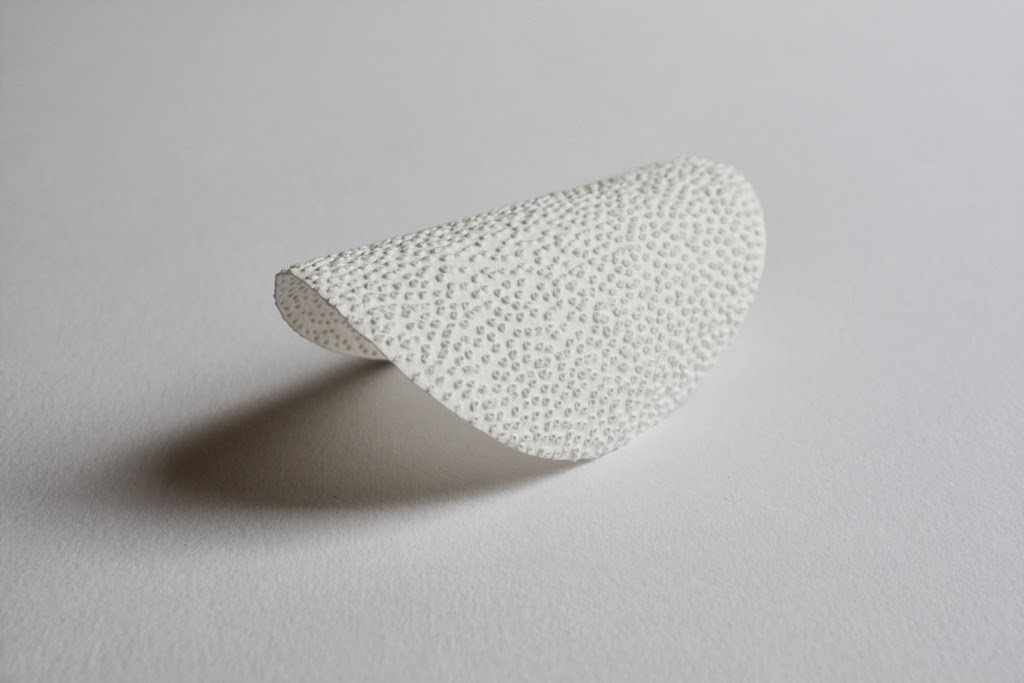
Back in 2009 when I had another big creative block I was studying Richard Serra's Verb List (1967 - 68) at the time. It is a list of words to describe artistic actions and possible instructions for activities using different materials. It resulted in me piercing hundreds of holes into paper using a needle, which I have been doing ever since!

Perhaps I should draw some of the words and / or themes that keep popping out in the literature that I read? Perhaps these themes are already in my work. I think so.

In a website article January 2014 from the arts organisation Artquest, Performance Artist Paul Hurley recommends that you should cultivate a life practice, with one's art practice a part of it. These are wise words. Where does my art practice fit into my life? How and in what way can it fit into my life? Productively, successfully, proportionately, wholly.  (http://www.artquest.org.uk/articles/view/how_to_be_a_performance_artist)

The thing to do is to start something. Not anything, but something. Take an A4 piece of paper. Take a pen. Open the wire threads and paper yarn that have arrived. Start stitching.

Be positive. Stay positive. Don't give up. Be patient.

Big sigh.


 'Untitled', Plasticine Figure, Circa 2006.

!

Tuesday, 22 April 2014

Blog 47

I feel a bit stumped at the moment. After a flurry of practical activity I'm feeling a bit flat. Perhaps I'm in a consolidating phase, processing mentally what I've been doing practically. Creativity tends to come in fits and starts, bursts and trickles, making and thinking, then thinking and making.

My last blog talked a lot about sewing and I am in the throws of organising some samples to be delivered of paper yarn, wire thread and retroreflective (glow-in-the-dark) thread. I'm questioning the materials I am using, are they the right ones? Materials vs. process.

So I've been 'pottering' about, an awful word to use. Sorting out the studio, again, de-cluttering, again, putting things away, streamlining what is in front of me. Streamlining a number of things.

Publicly I have had work in exhibitions every month this year so far. From Nottingham to Edinburgh, Leeds and now Glasgow, and soon to be, Bath, which is excellent news. Applying for more things, submitting smaller pieces, I am taking a different approach and curators like my work. But I would like to make bigger, more substantial artworks and have more concrete projects ahead of me.

Where I live is a rewarding yet challenging environment. It is costly to get anywhere so unfortunately I have been unable to get to some of these exhibitions. It feels alienating. I feel like I'm experiencing some kind of strange phenomena. I wrap my work up, it disappears, then comes back to me, but I'm not involved with it in the interim. I've always been hands-on, participating with the setting up and taking down of shows,  joining in with curatorial decisions.

These next few months I have other work to do. My partner is head warden for a campsite and I'm going to be housekeeper for our two self catering cottages. They say cleaning is good for exercise and maybe the distraction will focus my artwork! I hope so.


Two of my artworks that are in 'International Glasgow: The Melting Pot' at Six Foot Gallery, Glasgow 10th April - 1st May 2014


Work ready for 'A Given Structure' being held at Fringe Arts Bath Festival (FaB) 23rd May - 8th June 2014


My latest drawings from 'pottering' in the studio. I felt compelled to draw them over a couple of days. I cannot explain what they mean. They remind me of the works of Louise Bourgeoise and Eva Hesse. I see associations with stitching, space and abstraction. 

Did anyone see the letter from Sol LeWitt to Eva Hesse that was circulating recently on Twitter? 


And one of my artworks being re-stretched by hanging it in the window. It had got a little squashed in transportation. It seems to have taken on a different slant in it's new position. 


Here it is in it's original state as presented in 'Overtime: Art and the Office' at SEIZE Leeds, Leeds 
26th March - 29th March 2014

Finally, my favourite artwork 'in progress' at the moment: 


Machine - holed, hand - stitched, crumpled - up, tissue paper.

Tuesday, 25 March 2014

Blog 46


For a long while now I have been collecting the packaging material that comes with your parcels. I have more than you can see in this picture. I like the structure, the shapes, the textures, the colours, the idea of recycling / re-use, even as a medium in the development of ideas only. But what to do with it all? 

Having not been in the studio for a while, properly, it's been a bit like starting anew, and I began by scrunching the paper material up, looking at it in 'piles', contemplating different possibilities...


In January this year I was in a group show called Discardboard looking at artists, designers and makers who work with cardboard. Work that I had done a little while ago, it has re-engaged my curiosity to work with cardboard again.

I've been trying to understand the concept of recycled paper and cardboard and searching on the internet. I came across a lovely article called 101 Ways to Recycle & Reuse Cardboard Boxes at Home, Work & Play. Have a look here 

Looking at the scrunchy 'tail' you can see draped over the cardboard box in the second picture of this blog, it reminds me of my hand-made paper yarn which I have been making with old dress-making pattern paper. It's not finished yet. How could I present this? As a ball of yarn, or a three dimensional drawing in space? ... Where does this fit into my work? 


I started to make some books out of the packaging material. 

And I like the idea of piles of paper, a 'stack'. But the paper is not completely flat having been manipulated in some way, used, drawn upon...


Last year I began a series of black pierced paper drawings which look more and more sculptural and book like. I would like to develop this further.

I have recently been given a second-hand sewing machine. This is a two-fold exercise.

1. I would like to do some dress-making again, which I haven't touched since I left secondary school. 

2. Having hand pierced paper for so long in my artwork, what would it be like to machine stitch holes into paper? The idea of the mechanical verses the hand-made...

I began very simply, machine stitching holes into some of the packaging material, to see what it felt and looked like.


I then machine stitched holes into the watercolour paper that I use for all my pierced paper drawings. Piercing by hand, as the needle goes through the watercolour paper, it pushes the paper away from the flat surface on the back, raising the back of the paper slightly, adding texture to the reverse side (see image above on the right). This doesn't happen on the machine. It is squashed.

My partner has given me some large sheets of white tissue paper that had interleaved some plastic sheeting that he uses at work. So I started machine stitching holes into that and then sewing thread through the machine stitched holes by hand.

This paper feels much more favourable than the watercolour sheets and not so thick and chunky, although you can get different grades of watercolour paper that I could try? I like the delicate nature of this tissue paper, it is light and fragile. 

Using a simple straight stitch and different threads, I have been looking at lines. Single, multiple, spaced out, together.

I like the tension that can be seen between some threads and their holes, very slightly puckering the paper along the line. 

There is something very striking about a single line of stitching across a tear in the paper. 

And because my lines are not perfectly straight and equal distance between them, the more lines you stitch, patterns appear to form, creating lines of disarray, ever so slightly.

I repeated the process of straight stitch and different threads using my watercolour paper but at the moment this work feels thick and chunky, not quite right.

I took some A4 lined paper and repeated the process of straight stitch and different threads. What is interesting here is that my hand sewn line does not lie exactly on the line printed on the paper and so there becomes two lines, the original printed ink line, and my slightly wonky stitched line.

Also, on the left hand side piece of A4 paper in the picture above, there is the perforated line that runs vertically between the torn edging and punch holes. Hmm...  In fact, if you look really closely, the perforated line looks like a row of stitching without the use of thread. Double hmm...

I repeated the process of straight stitch and different threads into some very delicate bamboo paper that I have, following the very faint lines that have appeared I'm guessing, during the manufacturing process of the paper. But this paper tears very easily, too delicate I think. What is interesting, is that I felt red thread worked well with this paper, not black and white, and I only work in black and white...

I returned again to use a similar opaque paper to the white tissue paper, this time, tracing paper. Tougher and slightly 'crispy' in texture, i.e. not soft, it was pleasant enough, and the multiple un-stitched vertical lines on the left hand side of the image above, look a bit like rain. Again, the more lines I create, the more they diffuse out in disarray across the page. 

I finished this block of making by stitching different threads into clear cellophane. It's actually the packaging that wraps around your birthday cards etc. to keep them clean before you write on them. I have a stash of this 'paper' too. The exciting bit was when I pulled the woollen thread at the end of sewing and the paper puckered up quite drastically. The piece became a sculpture, 3 dimensional. This piece reminds me of Karla Black who works with cellophane on a large scale. 

Taking notes as I make, I question why am I doing what I am doing, in an enquiring way. I am concerned this work has the potential to become too craft based. It needs a fine art context to it. 

I would like to develop the 'pierced hole' paper artworks that I am known for, taking this process into a new direction. I would also like to develop away from my blackening process which I have explained is very difficult to work with in previous blogs, Blog 43 in particular.  But this work has been my identity up till now and the results are successful. 

I found this drawing in my studio which I had done a while ago, drawing lines with an embossing pen onto watercolour paper.

The detail image on the left above, is from a body of work I developed in 2009. It is an embossed line drawing, but has punched dots in amongst the lines. The finished piece is hanging in our hallway. What about something like this, as a template to stitch into?

The right hand image above, again done some time ago, is a series of black lines drawn very close together. The lines give the illusion of fabric. 

What I'm getting to is that my pierced paper when blackened with pigment resembles a 'malleable textile', as quoted by Rebecca Gordon in an essay she wrote for my solo show in 2012. Can I develop this concept in a new way? 

This work is very much about relationships between paper, holes, and thread.

In my collection of papers I also have some scrolls of white cotton (?) paper, 1038cm long x 30cm wide. I don't actually know what the paper is but I brought it at the Centre for Chinese Contemporary Art in Manchester during our travels in 2010. Is there someway I could stitch into this paper to create a 'malleable textile'?

A list of notes I have written during the making process... Notice the cluttered, de cluttered comment on the right. I had a cluttered studio at the beginning of this exercise which I emptied out, which I now feel I have cluttered again! 

I do like to work in a simple way, using a simple process, and simple materials. 

I end this blog questioning why am I hand-stitching thread into machine made holes? And what is important? 

How can I develop these ideas further baring in mind the craft/making element, but within a fine art context?


Blackened pierced paper has been my identity up till now and the results are successful. How can I develop this further and take it into a new direction? The enquiry goes on.

Friday, 14 February 2014

Blog 45


These last few weeks we have been on holiday spending time in rural Portugal, a country we love very much. Relaxation was the order of most days as we both had had a very busy few months before hand. It was a time to spend together, chat, listen to music and read.


The first book I caught up with was one which I had brought in a charity shop during our travels in 2011 called Sleep by Ian Oswald. First published in 1966, this second edition was from 1970 and I loved some of English language used which seems so dated now. Ironically and unbeknown to me, I discovered a lot of the experiments on sleep in this book took place in Edinburgh. 

When I make my work it can be very meditative and I wonder where the subject of sleep may fit into this? From being dozy to asleep to wakefulness. When we don't have enough, what does lack of sleep feel like? What about the environment around us, our mental state and outside influences? How does this effect our actions?

I am sure the study of sleep has progressed much further since. It was a lovely gentle step into my reading fest.


I followed this by going completely up-to-date with an e-book published in 2013 called 24/7: Late Capitalism and the Ends of Sleep by Jonathan Crary. Oh my God. I stopped reading it a third of the way through feeling really stressed out. Aggressive, fast moving, quite depressing, the author talks about the latest experiments to control people's sleep, technology that enables us not to sleep and how we live in a global world which doesn't stop as time circumnavigates the globe. 

I will finish it. I am fascinated with culture and our modern world but this was not holiday reading for me. 


My next book I took a step back and read Waterlog by Roger Deakin. I had brought it home with me last March 2013 from my book-making course on the island of Iona. It is the story of Deakin's year of wild swimming in some of the waters in Britain. I had first learnt about this book back in the summer of 2012 when I had read Wild Places by Robert Macfarlene who was a friend of Deakin. I found the book, hmm, a little boring in places. There was a lot of reminiscing back to his younger years, clearly swimming an activity he loved. But I did like his tour of Britain, something we did from 2009 - 2011.

I love swimming, yet not done it for a while. One of my personal 'bests' in life was completing a swimathon for charity in the early 2000's. I have a photograph of me, head down in the water, one arm curved over out in the air, doing the crawl. I should have it out really. I see it as an image of sheer determination.

   
In early 2011 I read A Book of Silence by Sara Maitland. It is up there in my top list of favourite books. Maitland has since published How to be Alone in January 2014, the next step on from A Book of Silence. 

A lot in this book seems to be repeated from her previous text and Maitland admits the subjects of being alone and silence intermingle with one another. I live on an island and spend a lot of time alone, something I have chosen and happened upon at this time in my life. It may not be forever. The majority of the time I love it, very happy in my own company, but did struggle a little last year due to circumstances that I was uncertain how to manage. 

Maitland writes about how in our society we are encouraged to be individuals and yet it can be frowned upon, misunderstood, or feared why some people want to be, or are alone. Being alone links back to the subject of our modern busy (un) dependable 24/7 lifestyles. And how much solitude is too much? Are you a hero for stepping out on your own, or selfish? 

It is a personal line of enquiry and I want to understand why I like being alone and how to manage those times when it may feel difficult. Maitland suggests ways to do this, ways to be alone if you find it difficult to find time to do that, small amounts of alone time, and how to manage the balance of work, maintenance (i.e. chores, housework etc.) and leisure. We all complain of not having enough leisure time! 


By now I was well into the mode of reading and completed my holiday with Wanderlust A History of Walking by Rebecca Solnit which I had started in March 2011. This time I finished it and have since wondered if this book may be more significant than I perhaps realise at the moment. As I read through the book a number of streams of recognition relating to my practice popped up. Solnit dedicates a chapter to artists who incorporate walking in their work and regularly mentions thinkers, writers, philosophers, artists, creative types, who incorporate walking into their lives. 

There are all types of walking, from the pure physical need to exercise, to finding a place that helps you think, look, travel, encounter others, and seek embodiment and spirituality. 

She describes walking as reading, walking as writing, walking as making, walking as speech. 

In my 10 metre pierced paper scroll that I completed in 2012, Rebecca Gordon writes in her essay to accompany the work: The amplification in the film of the sound of the needle piercing the paper accentuates the rhythm of the work, the abstract sound reminiscent of the beat of a Gaelic waulking song. 

The fact that my scroll is 10 metres long is like going for a walk, where you can follow the holes and patterns from one end to the other. 

I have walked many a town and city and it is really the best way to see and feel a place, two highlights being Edinburgh and Amsterdam in 2013. But, I have only felt a place "really, really", twice in recent memory. Once when we were walking along the edge of the cliffs on the Southern Coast of England and the other, one of the three walks I took part in with artist Hamish Fulton in 2009 through the town of Canterbury in Kent. I remember hearing someone clattering about in their kitchen inside a house, and I definitely went "somewhere else", hmm, a kind of sleep? A trance like state? I didn't want that walk to finish.

Beyond the realms of reading, whilst we were away, I was delighted to be in a couple of shows in Edinburgh and disappointed that I could't attend either. I wrote about them last time in Blog 44.

The first was Discardboard, an exhibition of artists, makers and designers who work with cardboard. You can catch up with the show here: Discardboard and Interview Room 11

And What is Textiles? presented by Kalopsia Collective. Take a look here: Kalopsia Collective

I also had three small works in The International Postcard Show 2014 held at the Surface Gallery in Nottingham and one artwork has been sold. The show includes an exchange programme and I am waiting to receive a postcard from one of the other artists to keep.

I received an email whilst we were away to say that I have been selected for a group show in Leeds this March 2014 by the artist -led organisation called SEIZE Leeds. A press release has just been published and I attach a copy for you to read: Overtime: Art and the Office I'm really looking forward to being part of this show.

We are home now. I have one more task to complete for Shawn and then hope to get back into the studio the next couple of weeks. For us it is the start of 2014, albeit just on seven weeks since 1st January. Happy New Year everyone.

Thursday, 19 December 2013

Blog 44

During October and November this year I had a good spell of practical work making new pieces and developing my ideas. This followed on with the task of documenting and photographing the finished art works and then these last few weeks have been about submitting for exhibitions and places to show my work. With two acceptances, one rejection, and three more answers pending, it's a good end to this year.

One of the shows is a postcard exhibition that includes an artwork exchange programme and the chance to swop artwork and connect with other artist's outside your area. To find out more about this show take a look at The International Postcard Show 2014

This is what I have submitted:


'Untitled' Embossed Paper 4 x 6 inches


'Untitled' Embossed Paper 4 x 6 inches


'Untitled' Pierced Paper 4 x 6 inches

I like working this size, and in series, and there is potential for this work to go on and on, forward and further. I like the way the paper is slightly distorted from my mark making. With the third image, the single line, the right hand side of the paper flaps. It's attached to the other side but fragile and might come away at any moment.

I have made more postcard artworks and am sifting through them at the moment along with the photographs I have taken of each. It's interesting how when I look at the work for real and then how I view it as a photograph. I'm actually liking them as a photograph. The more distorted the paper (pierced paper), the more distorted the structure and layout of the photograph is. The wonky lines and edges of the artwork in the straight edged picture frame play tricks with your eyes. 

The other acceptance is for a show that will present art and design that is made with cardboard and there will be a series of workshops and talks around the subject of cardboard during this week long exhibition. I am presenting some work which I completed in 2010. This time it will be in a new setting and I am keen to see how the work displays within a new space and context. 


Pierced Cardboard Detail

You can find out more about the show here: Discardboard

In my last Blog 43 I spoke about the need to change the process when I blacken my paper with pigment. I have had a very good chat with a technician at Atlantis Fine Arts Store in London who supply the pigment and the bottom line is there can be no change to my process unless I alter the aesthetic of my current artworks which would be a great shame for all their glorious deep dark black colour, powdery texture and velvety look. I mustn't change this and the debate goes on. Where can I blacken my work and secondly how can I take this work forward, in a new direction?

The technician and I did talk about using an air gun and experimenting with different mixes of powder and binder to get the finest and driest black spray onto the paper, but this is still messy work and involves an expensive piece of kit.

This year has been a mixed bag both personally and professionally. I was part of a group show in Amsterdam during the summer, my first international showing and I am part of two group shows for the beginning of 2014. I hope more will follow.

In March I went on a book making course on the very small island of Iona and in May I went on a research trip to Edinburgh and Dundee which was thoroughly enjoyable and very useful. I hope that I can get out to more places this next year.

I have focussed a lot on technology, mostly to improve my computer skills, my portfolio and communication. My photography does need improving and I would like to invest in some daylight bulbs both for the studio and when I take photographs of my work. This would help standardise my images and photographic process. I spend far too much time in our ever changing climate waiting for that illusive moment when the light is right to take a photograph and I would like to spend less time on Photoshop trying to rectify my mistakes. I do struggle with photography and accept my work is very hard to photograph. The skill is in taking the image correctly in the first place and I need to improve on that.

My art work itself has developed more slowly this year although there is the suggestion of something new occurring. I still keep returning to piercing paper and it seems more sculptural.

Now it is time for Christmas and as we start a new year I will keep at it, making, developing, applying, communicating. I love it. Lets see what happens.