Thursday, 16 April 2015

Blog 54

These last few weeks I have been stitching, assembling and constructing. I have very slowly been hand stitching, joining our patchwork quilt together ready to put into our van.


Example of stitching lines at the back of the quilt.


Hand stitches in detail.
Each stitch is between 1 - 2 mm and I have approximately 40m of fabric to sew!

Wanting the work to look good both on the back and the front, neat, precise and uniform, yet with the touch of the hand - made, this stitching process reminds me from when I was piercing my 10m scroll of paper in 2012, the act of taking a large scroll of material and mark making it, little by little, bit by bit. 

I am re-learning how to make garments again and have nearly finished my first piece. I am also learning how to alter existing garments that I have, un - doing things, re - sizing, re - constructing. 

I have disassembled our footstool cover, re - constructing a new version in a new piece of fabric, using the old pieces of fabric as the pattern for the new one. 


Remnants of the footstool cover.

I had a discussion with my Mum and she talked about her memories of Nan creating loose covers for client's furniture, and how amazed she was, remembering as a child, seeing nan convert something that was flat into something 3 dimensional, with very little instruction. 

All my activity is in readiness for moving back into our motorhome, along with an urge for 'make do and mend', re -cycling, up - cycling and sustainability. Ah ha, I am a very new to the idea of sustainability and what exactly does this mean?

There was an artists residency recently at the An Tobar Arts Centre on the Isle of Mull for which I went to the open evening discussion to talk about what roles artists might play in the future, in a more sustainable society. How can artists' roles contribute to a greener, healthier, more equal planet? 

Whilst we did diverge a bit, the chatter was thinking about how to live in a cohesive way within the community as a creative. To make sense of what I am trying to say more clearly, take a look at the website of the organisers of this event, Creative Carbon Scotland, who have documented it much better than I ever can http://www.creativecarbonscotland.com/mulling-on-mull-2015-artist-residency-reflections/

I think there can be friction sometimes between my art and the life I lead with my partner. Moving back into our van and travelling again, where we stay and how we survive, will become more important than ever. How we sustain ourselves individually and as a partnership. Big stuff huh! but I'm thinking about it more and more, taking some action at a mini scale. 

A while a go I picked up the 'Crafts' January / Feburary 2015 Magazine. I haven't read this for a long time and it was really to have a browse, along with thoughts of how can I sell my work and make money, hopefully through my practice, whilst we are travelling? 

The written language seems different to my arts journals and there is much more emphasis on the act of making. From making being an essential thing to do for the human being, to the development of ephemeral works that may not last, with the act of making the piece a very important part of the process. 'Street Craft' where creations appear without being asked, within public spaces, unannounced or anonymously, and a discussion between where an artwork is made to where and then how it is displayed. 

This last mention often feels problematic for me as the act of making my work is very important to me, the experience of creating it often out weighing or at least in competition with the work's public presentation. I think about the numerous exhibitions you apply for, fitting your work to the gallery's brief and not the other way around. Perhaps this is why I am struggling with my practice at the moment, needing a brief, yet not needing a brief. Making, yet not having an end goal. Note, you don't always have to have an end goal.... I really struggle with visualising how an artwork will or could look, or could be presented publicly, whilst it is still in my studio. I follow what is happening in the exhibition world but there seems to be a huge chasm between my work in the studio and how it 'could' end up and be displayed. 

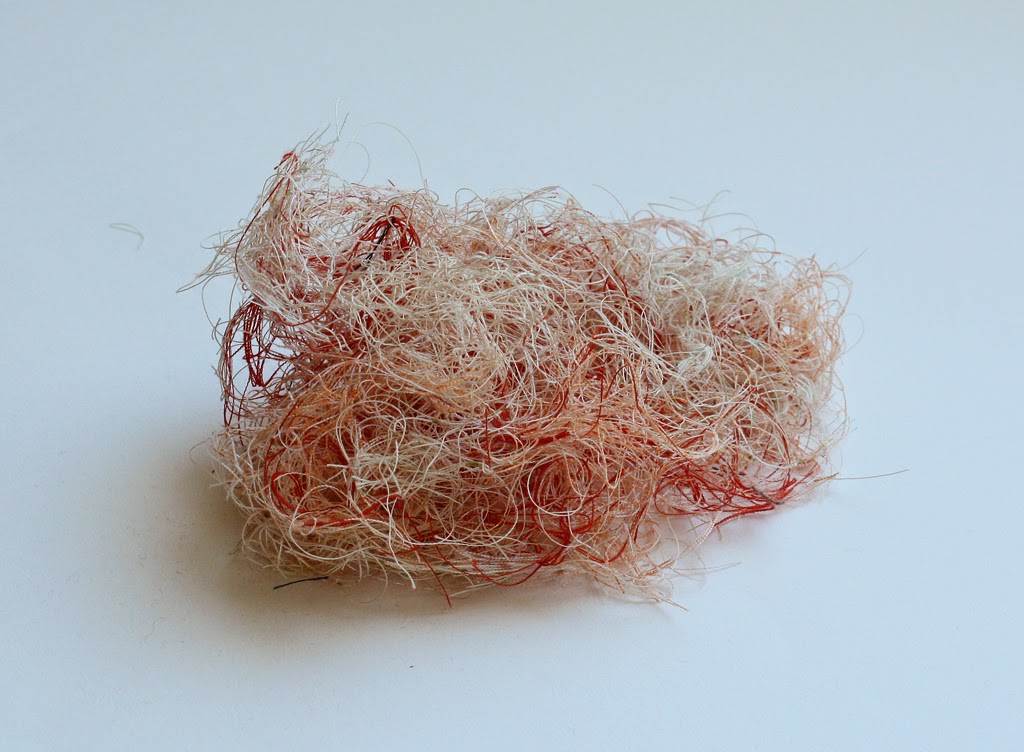
So, back to the quilting. When I was machine stitching all the patchwork squares together I acquired a lot of loose thread. I rather like it as a sculptural object in it's own right. It is like a 3 dimensional line drawing, a squiggle, a doodle. I am fascinated by the space between the threads, how the threads are suspended within the 'clump'. How is that? Each ball of discarded threads represent the residue or record of a meeting between maker and material. 


Artist Ness Donnelly also likes her waste thread. Take a look at her blog and scroll down to 'Transition II' written March 25th 2015. She has stitched her short lengths of waste thread into a new piece of cloth  https://nessdonnelly.wordpress.com

Perhaps I should create some paper patchwork 'quilts', taking the idea of this process and using alternative materials? What would they look like? How would they feel to touch? What stuffing or 'wadding' should I use between layers? Does it need these layers?

I have worked with dress makers paper patterns throughout my art career on and off, initially making a body cast in 2004 for my end of year foundation course show to my ongoing (not finished), dress makers paper patterns, paper yarn, which I am still 'spinning' since March 2013. I haven't finished it yet!

In May 2013, Hormazd Narielwalla presented five 'Love Gardens' sculptures made with paper, coloured acetate, glue and staples, inspired by old military suit patterns. They are fabulous. Take a look here from fashion blogger Disneyrollergirl:

And to see more of Hormazd Narielwalla's work with garment patterns here is his website:

So, how do I finish this blog? Still no completed, what I feel are presentable artworks, but I do feel there is the ground work, a bubbling of ideas, both solidly (actual real things) and mentally (thoughts in progress). Who knows how these activities I am currently doing will bleed into my art practice more fully? 

I end with a link to artist Deirdre Nelson who has been working at Timespan Museum and Arts Centre up in the Highlands of Scotland on a residency called 'm a p MAKING'. She is exploring what is being made around the area, and looking at that which is "often not considered creative or artistic". As you will see, all sorts of things are being 'made'. Here is her blog: http://dstitch.blogspot.co.uk

At the moment there seems little correlation to my pierced black paper artworks that I present as my most recent portfolio for my art practice. But is there, however remote it may seem right now? The first sentence of my artist statement on my website says "Emma Moody-Smith's practice explores the process of making" Hear hear!, I say. The second sentence says "She investigates artistic and everyday actions asking, why do we make things, keep things, covet things?" Hear, hear!, I say again! 

At the moment it is all about 'the making', albeit mostly for myself and our home, and I am enjoying it. My artist's declaration and my act of making match up, it's the visuals perhaps, that seem confused?

Saturday, 14 March 2015

Blog 53

Creativity has taken charge instead of blog writing and whilst the creative juices have been flowing I didn't want to interrupt with the formality of explaining what I've been up to. I will try to do that now.

In January we had our annual holiday, taking time out in Southern Scotland in our RV motorhome. On our return I was back in my studio drawing simple maps, trying to make sense of my relationship with the Isle of Mull where we live. You see, we hope to leave here this year and start on a new journey in our van.

The map drawing didn't last long and I started to abstract the Isle of Mull shape into a simple triangle. Using graph paper as a simple structure to draw from my marks became stitch like, imitating fabric and thread.


As we prepare to move back into our van I am slowly 'de cluttering' my studio with a desire to use what materials I have left in it without adding too many new ones! I have some tissue, Japanese scroll, tracing, and hand-made cotton rag 'Khadi' paper which I would love to use up before we go... 

Last year I was stitching into the tissue paper. I really like it's delicate and translucent nature. It is quite fragile. 


In between drawing I've made a batch of hand-made books using up my stash of packing paper that you get in parcels, and left over drawing paper which is marked and 'un usable' in it's marked state. The aim is to use these instead of A4 pads, and I like the idea of recycle, reuse, 'make do and mend'... There are more books than this. They look like old school exercise books. Each has a pocket to put things in, and each sheet is perforated so I can tear it out if I wish to transfer the paper/notes to somewhere else (I keep notes and clippings interleaved in my reading books with the information on it relating to a specific article or topic in that book). I've kept the cotton loose where I've stitched papers together. 


In the image below, I've stapled scraps of paper together. I like their layering effect, being able to see one sheet under and over the other. It looks like a book, with connotations to the multiple sheets of paper that make a book.


I think the image below was a turning point and I particularly liked the drawing on the right where the pen has leaked underneath the graph paper. It looks like some sort of netting.


Last year I made a mini white cube box to put things in, to imagine how they would look in a gallery space. I struggle with being able to visualise how an artwork would look when presented in public. Whilst the focus should be on the making process itself, you've got to have some idea, even an inkling of how something could be presented. 


Whilst the scale may be out, perhaps the materials slightly adrift, imagine the above as an installation in some way, you walk into it, under it, on it...

I began to flip between stitch drawing and pen drawing. I enjoyed the methodical process of creating squares. I was calmer when I made these stitch drawings, except when I pierced a pin up and underneath my fingernail! Big ouch! I don't recommend it.


The key words to describe my practice are process, material, craft, sculpture and performance. I think at the moment my work is about 'paper, fabric, stitch and draw', and I think the link to sewing is because of all the sewing I have done these last few months (separate to my practice). Is sewing as a process a positive influence or a negative conflict to my current art practice? I mean, I pierce holes in paper with a sewing needle and have been doing so for a long time, but is stitiching and using thread the next course of action to take, or is it too direct? Is this too literal a step in moving on from piercing paper?

I've been sewing into muslin, again a transparent and fragile material, and I like it's fine grid of vertical and horizontal threads.


In the past I have imitated fabric through drawing with an embossing pen, and ink, but I don't think necessarily this is the way forward now? I discovered an artist last year who creates fine line drawings, like my black ink drawings below, on copper and aluminium sheeting. His are stunning artworks and I don't want to compete with that. 


But my pierced paper with pigment artworks that I am known for do have a fabric like quality about them which is part of their success. 


Blackening paper with pigment is out, unless someone can provide me with a work space to do this. It is a very messy process. But should I be doing more work with pierced paper? Make it more sculptural? What? Part of me feels my piercing process is not yet fully resolved and yet part of me wants to move on to new things. On a practical level, piercing paper for a long period makes my hand and arm hurt and I don't believe this is a good thing long term. 


I near the end of this blog by sharing the image below where I have stitched wool into cellophane, you know, all those outer plastic sleeves from cards that you send to people. The piece feels completely useless as an object, and yet I like the natural wool against the artificial plastic, and the way I have pulled it in and the gathers. Huh? Why? What is it about this piece? 


I have a stash of outer plastic sleeves to use up, again needing to empty the studio and the idea of recycle, reuse, 'make do and mend'. You may ask why I've even kept them, for someone who is so into 'de cluttering'?  I don't know ha! It's their transparency, their clearness, materiality. 

The artist Karla Black makes sculptural works using cellophane, combining it with other household materials such as vaseline, flour and make-up. Should I make a big batch up of wool sewn cellophane sleeves and see what happens? It feels a very crazy idea, both positively (why not?) and negatively (it's not the right thing to do). 

As I finish this blog I check through my notes and see the word 'embellishment', a single word, on it's own. I think this is what I am trying to do, make a mark or lots of them on something, in some way. 

Paper, Fabric, Stitch, Draw.

Wednesday, 17 December 2014

Blog 52

After two months I have finally finished repairing all the inner walls / fabric partitions in the Shieling tents. Hooray! And now I can return to my artwork. First task - submitting for a couple of shows for next year, and second task - write a blog before the year runs out!

I think this blog is about repetition and the continuing act of getting up and sewing each day - same time, same process, same challenges (the positive word to describe 'problems'), perhaps with some moody fluctuations in between - frustration, despair, anger, anxiety, relief, distress, happiness, happiness??

I have been working with a polyester satin fabric which is bright yellow - what a nightmare of a material - it is very slippery and frays like hell! The challenges of material and process.

The work has been physically demanding and mentally challenging and I would come in in the evening exhausted having used up all my concentration, so very little 'art' was done during this period, but at least I was 'making'.

I always try to keep up with what's happening in the art world through social media, reading blogs, journals, newspapers etc. even if I am not making artwork itself, and as I went through my notes and jottings that I have collected over these last two months at least five articles referenced the subject of repetition.

In 2003 an article called 'Eternal Return' was written by Brian Dillon and published in Frieze magazine. Dillon describes different types of repetition and I quote:

"the relentless crawl to infinity that is the experience of boredom," i.e. something to do.

"or the equally unreachable horizon of obsession," i.e. a goal, an aim, you never quite achieve, or do you?

 and "the repetition that results from forgetting" i.e. you do something all over again, and again.

In the exhibition titled 'Down to Zero', curated by Michael Roberts, he presents a group of artists who start from 'zero' when they begin a new piece of work, setting up rules and boundaries as a starting point for their creations. These rules and boundaries can be broken or altered in due course and often repetition in some form or another takes place. One artist describes using rules and boundaries as a way to reduce having to make decisions on the way and then, what I call 'happy accidents' occur, during the repetitive process - chance, mistakes, improvements, new direction and so on.

There is a twenty one step specification that I have written for how to make a patch for an inner wall / fabric partition in the Shieling tents. This process is repetitive, monotonous even at times, yet with nuances taking place all the time - the cotton runs out, the machine decides not to work, the fabric puckers up, the electricity goes off - oh that's because we had a storm...

I wrote on a post it note a single word one day, date unknown, the word says 'Interference'. I think it was because I was getting frustrated by all the distractions stopping me from doing my own artwork - some my own doing, lots outside of my control. Oh that's called 'LIFE' Emma!

One book that is high up on my list of favourite reads is 'The Poetics of Space' by Gaston Bachelard. I have since discovered two more texts that sound interesting - 'Voyage Around My Room (1794)' by Xavier de Maistre and 'Notes Concerning the Objects that Are on my Work - table (1976)' by Georges Perec. All three authors write about how we and our objects inhabit space. How do I inhabit my space - the house, my route to and from the workshop, my work station in the workshop, mealtimes...?

The text 'Notes Concerning the Objects that Are on my Work - table (1976)'by Georges Perec was discovered in another Frieze Magazine article titled 'In its place' by Declan Long. Long writes about the artist Uri Aran who presents work-tables in exhibition spaces showing his ideas and artworks in progress. Long describes these work stations as 'cryptic bricolage' with a 'general air of mental muddle'. As the viewer you have to work out what is going on - the artist's thought processes, his connections, make your own new connections. Long describes Aran's tables as "transitional arrangements, with transitional meanings". I think that's how my own studio desk is right now - a bricolage of works in progress that I need to re-familiarise myself with having missed them for two months!

When I have come in from sewing all day I have needed to do something to relax and unwind. My eyes were too tired to look at a computer screen or read a book and I was too 'wired' to listen to music or gosh, even dare to sit and do nothing, so I enjoyably stared at the big TV screen and watched a number of classic films - 'It's a Wonderful Life (1946)', 'Casablanca (1942)', 'Breakfast at Tiffany's (1961)', 'Millions like Us (1943)', 'War of the Worlds (1953)', to name a few. One of my favourite times at college was our art history lectures and often the tutor would talk about or reference classic films during the lesson and now I have finally got to see some of them. I am particularly struck by the setting, the costumes and props, story line. They seem outdated now, perhaps clumsy, humorous, or 'quaint' at times but what is best is the fact that the films are an interpretation of someone's imagination.

In 'Millions like Us (1943)' it is about a young girl who goes off to work in a munitions factory, all part of the 'war effort' of the second world war and all this made me think about my previous career when I worked in the food manufacturing business helping to produce vast vats of sauce or cake mixture or vegetables and brine to be packed in foil trays or glass jars along the ever moving conveyor belts. And like wise now, the hand - made production of innumerable patches for the inner walls / fabric partitions in the Shieling tents. I'd be good in a factory, that's where I come from. Production, process, repetition, "p p p p procedure" - my friend will know I became to hate that word...!

As I end my last blog for this year I've been talking really, about the monotony of life, the every-day, the banal, and repetition. Next week it will be Christmas, again, an event that happens every year, again, and it is on this note that I'd like to wish all my family, friends and readers of this blog a very happy, if slightly repetitive, Christmas!

Now to the third task - go and assess that artist's 'muddle' on my studio table.

Wednesday, 5 November 2014

Blog 51

I am helping out at the campsite where we live at the moment repairing all the large 2.5 x 3 meters inner walls / fabric partitions that are in the Shieling tents. There are twenty eight of them to do,  removing all the mould, ingrain dirt, traces of insect marks. It is quite physical work dragging the voluminous heavy material across the floor and pushing it through the sewing machine. I am working on my hands and knees a lot of the time because of their size, and the industrial sewing machine I use is a bit of a beast.

It is a shame I am not making art at the moment but at least I am 'making'. And it is about process. Measuring, cutting out, pinning (piercing), stitching, straight lines etc etc. I have written a twenty one step specification for the person who will continue this role in my absence. An instruction manual of what to do.

As well as this, my partner Shawn and I are in the throws of updating the interior of our van in readiness for our departure next year and I have a growing list of mini projects to complete before we go, mostly involving fabric.

I would like to make my first patchwork throw. Again whilst this is not about making 'art' per se, it is about being creative and the act of 'making'. Patterns, geometry, design, abstraction, measuring, cutting out, pinning (piercing), stitching etc. etc.

I have discovered the work of quilt maker Lindsay Stead who creates geometric, minimalist style quilts, using a very limited palette of colours, shape and design. I like her ideas very much.

I have applied for a couple of shows, unfortunately a rejection by one, and awaiting news from the other. I do have some work being presented in a group show in London next spring, dates to be finalised.

There was a good article in our local magazine this last month titled 'The importance of lying fallow', and I quote the opening paragraph describing the definition of Fallow:

- adj. 1. (of land) left unseeded after being ploughed and harrowed to regain fertility for a crop.
- 2. (of an idea, state of mind, etc) undeveloped or inactive, but potentially useful.

Within the text the author describes how the fields on her farm were left fallow for a year so that the ground could 'heal', nutrients be revived, with no requirements made in the interim.

I think that's how I feel at the moment as an artist, undeveloped but knowingly useful, or is it harassed (rather than harrowed), wanting to be creative within a fine art context but having to work on other projects ha ha!

With the emphasis on these other activities for a while, will these deviations feedback into my artwork? There are similarities. I do hope so.


Sizing up a new patch for one of the inner walls of the Shieling tent.

Saturday, 27 September 2014

Blog 50

I am back in the studio exploring my black paper samples, in pursuit of the idea of pierced black paper without the use of very messy black pigment added to it. Would the samples be comparable to my original pierced black pigmented artworks? Could they be better, worse, or just different - a different aesthetic / piece of work?


I have also embossed the black paper samples to see how they compare to my previous white embossed artworks.


The reflection of light on the marks on the paper, it's visual clarity, varies so much depending on where the work is placed in the room and at what time of day, including what lighting is used, natural or artificial. This can have it's own meaning, a subject to play with, but is tricky to manage or control. My work is about process with the end results about that process.

You may recall my white pierced sculptural circle:


which led to larger versions of pierced circles: 


And blackened pierced paper circles:


I have now made some mini black pierced paper circles (without pigment) and put them with some white pierced circles.


There is more work that could be done with this idea based on repetition, scale and installation? It feels like I am painting in 3D. But is my material quite right?


So I have been thinking about piercing paper and embossing paper and particularly finding a replacement for the very messy process of adding black pigment powder to the paper surface.

I have been following the excellent #BBCFourGoesAbstract season on the television. It is very informative, abstract art, a subject I don't know much about. 

I see my pierced holes and dots as individual marks within a mass of marks, yet each without a specific meaning. An abstract. Mass. 

After I had taken the photograph above, when I looked at it, it looks like a collage, an abstract composition. But how could I interpret this into an artwork?

You notice a splash of red - red acrylic paint - brushed onto pierced paper to try and find a powdery pigment replacement. I always work in black and white. I am not a colourist in any way. Anish Kapoor says that red makes a kind of black. I have an understanding with what he is saying. Was this an instinctive choice why I used red? Another artist, Bernard Aubertin, introduced to me in 2013 makes artworks only in red or black, sometimes gold. 

But really I like the colour palette of the black paper samples themselves, best of all.


My line of enquiry is to find a replacement for the very messy process of adding black pigment powder to the paper surface. Following the likes of Yves Klein and Idris Khan I feel I need a finished powdery surface which is lighter and more delicate. 

At this stage after many experiments it looks like a Gum Arabic solution is coming up trumps verses Somerset Black 280gsm Paper. I like the idea of using Gum Arabic because it has a relationship with watercolour painting and I use watercolour paper as my base material. But there are more experiments to be done first.


These new works will never be the same as my original black pigmented paper, but perhaps an alternative, causing a different work of art, with a different aesthetic?

I have also been following the conversations on line about Kazimir Malevich's Black Square 1929, in relation to the Tate Modern Exhibition of his work which is open at the moment (16 July - 26 October 2014). This has led nicely onto the #BBCFourGoesAbstract series that I have been watching on television. 

You see I have been making squares and frames for a quite a while now:


And I don't know why I have been doing it specifically...

And this summer, when I was drawing, I made these two sketches:


And this was before Malevich and #BBCFourGoesAbstract series kicked in...

I end by saying that during the summer I was given a box of unused foam mount board, no longer of use to it's owner. I have decided to make 'white cube' boxes as maquettes for constructing visual ideas for display of my artworks. The 'white cube' gallery is perceived as the optimal space for an artist to exhibit their work in, and is not for everyone. But these spaces can be painted different colours, carved into, fabricated, changed, if so desired. I need to find a way to visualise what I see in front of me when I am making, and how I could display it in an exhibition, for the viewer.  At the least it will give me something to work towards.


And look at all the cut off remnant foam board pieces. Those triangles. This material makes building blocks of it's own. 


I think I need to spend some more time looking at what I have done. Study the different elements. Move things around a bit, physically, in the studio, at the desk, and mentally.