Friday, 10 June 2016

Blog 60

These last few weeks I have started mind mapping to try and unravel my thoughts and actions. This is a new way to work for me and I'm not always finding it easy. The content is strong but the visuals weak. However as I am reminded it is for personal use mainly and doesn't have to look pretty or accurate or 'perfect'. What do these words mean anyway?

What is good is that I am starting to take action from some of the content in the mind maps. 

I cannot draw, at least in the conventional, expected sense. I can write. I'm good at writing. My mind maps are very text based at the moment, that is what comes most easily for me to do.

I hope you can read the words in the images below. Click on the photographs and scroll in further if you can. 


The mind map above is about what is important to me and what I do and would like to do. I describe our life as 'van - centric' in that it is our motorhome or 'van' that is the most important thing to us. It is our home and the space we hang out and live in. 

I am interested in Permaculture, most so as an attitude and approach to living. I'm not into the gardening, not yet, but trying to establish how we currently live and can live sustainably, comfortably, realistically and within our means. 

The 333 challenge refers to the Blog 'Be More with Less' and I attach the link here: Be More With Less

I aspire and want to live a more simple life, free of clutter, physically and mentally. It is a continual work in progress. I want to reduce the clothes that I have, or change them, reduce the kitchen objects we have, reduce the food / store cupboard excess we have, reduce the folders and paperwork that I have. 

I have an arrow pointing to time management, that needs improving because I don't always get it right, missing out or trying to do too much, and generally knackering myself out in the process. But what would I give up in that process? You will notice that I include the statistical percentage numbers recommended 'one' spends on each area of their art practice. Does anyone else achieve that, and how?

I want to read, I want to make, I need to rest and I want to spend time with Shawn my partner. 

When I think about my artwork it is simple, using simple processes and minimal tools and materials. It is the complexities behind that are perhaps cluttering it up.


Drawing got the better of me and I slipped back into text and lists with the mind map above. Is it a mind map even? Probably not, and not that that matters either. The page is a summary of the mentoring session I had whilst in London in April this year, picking out key subjects that my work is about or could be about. Key questions are being asked, and I may not take action on all that is here. Lots to think about... My mentor thinks I should write a manifesto to establish and clarify a few things and give me direction.


I love reading and never make enough time to do this (it's that time management thing...), and I have a number of books stashed in the van waiting to be opened and read. For the mind map above I have tried to break my reading list into subject matter to give me some direction and order of which books to read first. I can see where the different subjects link up. Me spending a lot of time of reading isn't very exciting for others to follow. How can I share my excitement, enthusiasm and knowledge of what I'm reading and learning via my social media platforms? How can I convert reading into something visual? What is my relationship between reading and making? 

I have a number of notes from past books that I have read, important books to me. Perhaps I should revisit these notes and mind map them to unravel what I have learnt or struck upon from reading these books? 


Another list above. Whenever I exhibit or what exhibitions I apply for, the shows should always be along side my own interests and practice. I am learning more and more to say no when exhibitions don't fit or feel right with my work. This can be hard, not wanting to miss a potential (will it be?) opportunity. I am happy with my exhibition history so far and can see how each show links from or with one to another but I would love it to expand a lot more. 


And finally in the image above, these last five years or so I have been collecting information under key subject categories that have particularly caught my eye or are relevant to my practice. I wrote the list of folders out to remind myself what these subjects are and the use of these words act as triggers reminding myself what is in each folder. In decluttering mode, I think it is time to sift out some of the paperwork that is in these folders.

I recaptured what Rebecca Gordon wrote about me in her essay for my solo show in 2012 in that my work is about materiality, process, craft, sculpture and performance.

The conclusion that I have come to is that I know a lot of this stuff already and need to delve deeper, just as my mentor said. He also stressed I should 'chuck out' all the irrelevancies. 

So it is time to start reading and time for more decluttering and hopefully these activities will activate a new body or extended body of work, I do hope so.

I have brought some coloured felt tip pens to aid my mind mapping technique. 

Thursday, 5 May 2016

Blog 59

I have read three different blogs this week from fellow creatives who have recently been on business and research trips, one in Chicago, another from New York, and the other in Poland. I myself have been on a research trip this last month to coincide with an exhibition I have been in with the artists group Plastic Propaganda, this time home to Kent, with the show taking place in London.

Our show was called 'Both Ends of Madness' exploring the human need to create as a kind of necessity, to the therapeutic benefits of creative making whether you are an artist or not. Our group are very dispersed internationally and it was lovely to catch up and meet new friends.

At the beginning of my trip I had a very much needed mentoring session with the outcome really suggestion that perhaps I should step back slightly and purposefully write a manifesto. Whilst I continue to make new work seemingly and continually in it's infancy, what really is my subject? And just as important, to help as a guideline, what is my end goal? We went from talking about Biosemiotics to silence, existentialism, the ephemeral, acts of intervention, process as meaning, the meaning behind making and ways to present 'slow' work. I have a lot to think about.

Our host where we are staying in Portugal has recommended the methodology of 'mind mapping' to clarify one's ideas, thoughts and feelings. I have brought the e Kindle version of 'The Ultimate Book of Mind Maps®' by Tony Buzan so we'll see how I get on unravelling my buzzing brain. Maybe I'll create some artworks out of this activity?

On this note I would like to share with you the work of Lucy Gresley, fellow member of the Plastic Propaganda group. If you go to her webpage under the section http://www.lucygresley.com/#!thinking/crpi , there is the wonderful 'Practice As Research Poster' 2015 which she has created (third image down). The title of this section of artworks is called 'Thinking'.

I tried to link up with a number of creative people whilst in the area. I had the pleasure of spending a morning with Hannah ten Doornkaat. An experienced artist and fellow twitterer, it was our first meeting. Hannah generously showed me round her studio, sharing her finished artworks, new ideas in progress, telling me about her exhibition activities, experiences of selling work, thoughts on what I could do, and generally the ups and downs of being an artist. This visit and our conversation was so nice for me as it is something I don't get to do often enough, thank you Hannah. Here is Hannah's website: http://www.tendoornkaat.co.uk/home

I also had a morning with designer and artist Mandy Munroe. We have known each other a few years and took great delight in talking all things quilts and knitting. These skills are perhaps on the peripheries of my practice at the moment but I wanted to pick Mandy's brains and her expertise to increase my knowledge and get my creative thoughts moving in a broader way. These are not technical terms for quilt making and I paraphrase by saying I have learnt "it's all about the square", how to use negative space, low loft and high loft wadding and how you can create "hills and valleys", to name a few. These expressions give me titles for ideas, even if not with quilting. Thank you for your time Mandy. Here is Mandy's blog: https://mandymunroe.wordpress.com

Continuing with sewing I did spend quite a bit of time in the top end designer shops whilst in London. I am no fashion guru at all, and this was partly for my own dress-making, but I wanted to look at the different fabrics, how they are matched together and construction. I deliberately didn't look at the prices but you can understand and appreciate the craftsmanship that has gone into many of the hand-sewn or hand-finished items, which seems to be the 'in' thing? The quality of many of the fabrics are like nothing I have ever worn and the inside of many garments was just as neat as the outside in terms of tailoring skills, unless the 'unfinished' look was part of the design. Thoughts about shape, form, construction, sculpture, texture, abound.

As for art exhibitions I visited many whilst in London, too many to list here. My highlights were Sergej Jensen 'Moneybags' at The White Cube where I had my "oh yes" moment and Piero Manzoni 'Achromes: Linea Infinita' at Mazzoleni Art Gallery. I was so pleased to see a collection of this artist's work in one place.

I also visited 'Conceptual Art in Britain 1964-1979' at Tate Britain and 'Electronic Superhighway 2016-1966' at the Whitechapel Gallery. I have been described as a conceptual artist in the past and I like conceptual art but perhaps not always the visuals. My visit to the Whitechapel Gallery was in question to what is my relationship with the internet? I joke here and say it is a love/hate relationship! I think actually my favourite work in this show was Allan Kaprow's 'Hello 1969' where he linked up people internationally via a live television broadcast, with everyone keep saying 'Hello??'. It seemed very much like an early form of our modern day Skype.

By the way, it seems to be popular at the moment to curate shows with their timeline going backwards rather than forwards.

Talking of the internet I do just want to add Alex Evans blog link. He is the artist I have just read about who has been to New York recently, and the internet becoming key to his practice:
https://www.a-n.co.uk/blogs/networks-in-new-york

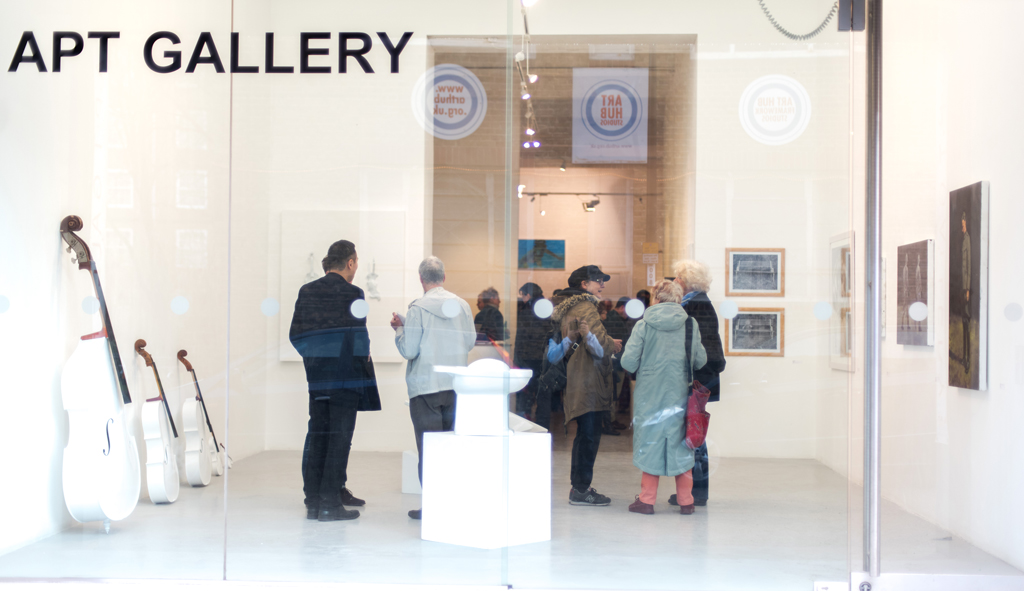
I finish my blog with some images from our exhibition in London. There are 200+ images to choose from and I apologise to those people I have left out. You are all here on my computer at home. Thank you to Jez Giddings for taking our images. If you would like to know more about this artists group that I belong to, here is our website: http://www.plasticpropaganda.co.uk


Setting up.


Ready to go.


A brief interlude whilst mopping the floor.


A portion of my work in detail.


Opening night.


Opening night.


Glimpses of our guests on opening night, through my work.


Opening night.


Deep in conversation, opening night.


Deep in conversation, opening night.


Deep in conversation, opening night.


Setting up - detail of Anjula Crocker's work.


Extended line drawing - some of the work of Lucy Gresley.


And more of Lucy's work - using Mohair wool mmmmm!


Mohair detail.


Public Symposium night.


A still of John Butterworth's film.


Looking out onto the street.


Tuesday, 9 February 2016

Blog 58

This blog post is all about making. It could read 'To Pierce, To Knit, To Sew'...

Some of the works I show below were made when living on the Isle of Mull in Scotland whilst others have been created whilst here in Portugal. They are developmental 'Works in Progress'.


My starting point - Pierced Paper, Ink Dots, Stitch Markings...


Selection of Pierced Papers - ongoing


Selection of Pierced Papers - ongoing


Selection of Embossed Papers - ongoing


Selection of Pierced Papers - ongoing


But what to do with them all?
What about a mass of pierced papers (bigger than this example)? 
Presented on the wall, on the floor, on a table, bench, or plinth... a kind of visual diary really?


What about stacking? Piles of pierced paper? (Obviously lots more than this).
When the paper is pierced it becomes voluminous. 


Examples of threads...

I like to knit. It is the most relaxing activity of all the things I do, at least for the moment. Above are some examples of the threads I am trying out. 


But what to do with all the squares?
What about stacking? Piles of black squares...? 

Obviously there needs to be lots more than this, and obviously neater and more uniform in size. Think architectural stacks. The verb 'To stack'? And by doing lots more, I should improve my knitting skills...

What about a free form knitted 'quilt' / 'blanket', that could be hung on the wall, or draped like the felt works of Richard Serra? 


The thick black wool I've used is quite stiff to work with, and the more threads you knit with at the same time, the tougher and more robust the fabric produced. It could be manipulated, moulded and has sculptural potential...


Perhaps some sort of adhesive, or setting agent would help each piece stay in it's sculptural position? Can anybody recommend something or a method I could use? Of course over time it might sag. I could call it 'To Sag'...


My favourite thread of all at the moment is mohair. I like how hairy it is and it is so light to touch and hold. Sticky, yet fly away. The nature of the thread's hairiness makes it very voluminous. Hard to show in a photograph, but I imagine a room full of mohair thread, unravelled, as it is. Yes, you would need a lot of thread and mathematically could work out how much you would need. It would be a kind of sculpture or three dimensional drawing. It could also be like a big tumbleweed... 


I have been wrapping...


And stretching...


A different thread - 'To Stretch'...

I imagine squares of knitted fabric stretched between pins on a wall. They might look like little maps? Think how many different types of patterns you could form just by tweaking the direction you stretch the square. 


Fishing wire, crocheted.

I'm guessing that people would like to see through the crocheted fishing wire or with all it's shadows showing, something like the photograph above, not with the olive trees of course.


I like the idea of the fishing wire on a white background. Again difficult to show in a photograph, but what about a free form knitted 'quilt' / 'blanket'? It could be hung on the wall, or draped like the felt works of Richard Serra? You would kind of see it and not see it, it's opaqueness.

And what about spread out on the floor - soft, billowing, bubble / foam - like, fluttering, oozing...


Black and white mohair thread knitted together - detail


Black and white mohair thread knitted together - detail

I like the combination of knitting black and white threads together. There is too much white here in this sample above, but I like the idea of random white threads 'just' peaking through the black. It looks like a drawing or painting, and due to the knitting process every square would be different. 


I brought the cream thread above when I found it in a wool shop on a car journey up to the top of Scotland. I've always really liked it and feel there is a connection between the wool and the watercolour paper that I use. I know the colour is the same but I'm not sure why else I'm drawn to it? How am I connecting the two visually, and how can I show that through making? 

Likewise with the next two images below, I feel there is a connection between the knitted fabric and the watercolour paper. I want to sew the two materials together. Why?


This piece above I have had a long time and it is one of my favourites. I like the left hand side with the cream mohair thread sewn through the cellophane, such a juxtaposition of materials. The cellophane is the outside wrapper from a birthday card. I have a stash of cellophane card wrappers. What would this look like sewn en masse? Karla Black, a well known Scottish artist creates large sculptures using cellophane. 


Having completed my first patchwork quilt for our motorhome this last year, I decided to try out this method using plain paper and pierced paper. I don't think it works, at least not yet. It is the wrong paper, too thick, chunky, clumsy looking. Too many squares. What I do like is how the pierced squares of paper are raised against the un-pierced, flat squares of paper, again the pierced paper is becoming voluminous and puffing out.


Simple is definitely best. Imagine this work above, on a larger scale, the un-pierced flat paper fixed to the wall, the pierced section hanging freely, kind of just hanging, dangling.


Mohair thread sewn into Pierced Paper.
I like the juxtaposition of textures.


I return to fabric. The two images above are of the pin cushion that I have made to use when I am sewing, when making art. I like it as a soft object on its own. I particularly like the lines of the seams, and where they join perfectly! Why?

April this year I will be presenting a selection of my black pierced paper artworks in London with the artists group Plastic Propaganda . It will be at the A.P.T. Gallery in South East London from 7 - 24th April. Our show is called 'Both Ends of Madness'. It is about the idea of the 'mad genius' and an exploration looking at artists who might struggle to make work in search of the impossible, to artists who use art making as a form of therapy. What leads to fulfilment in making and what are the therapeutic benefits of doing this?

My artist's statement explains why I like to make:

Richard Serra’s Verb List (1967-68), sets down the infinitives of 84 verbs and 24 possible forces and contexts as a linguistic bank of possible artistic actions in response to particular material qualities. Taking this as my starting point, my verb list might include: 

to de-clutter
to purge
to empty…

I like to pierce paper, gradually weakening its structure with holes until the once firm support bares more resemblance to a malleable textile.

Most times I work alone connecting art making to a form of personal therapy. The repetitive action of piercing paper becomes both a mental “displacement activity” and a test of physical endurance. It is a place to withdraw and explore my mental state.

Intriguing groupings of holes are formed that become dense chasms when blacked-out with pigment. I like the loose, powdery nature of this material, it is a free spirit, yet both messy and troublesome to deal with.

Ephemeral in nature, the fragile artworks I create are a form of catharsis, a madness of quiet and contemplative intensity. I like to think that I can provide the viewer with an entrance point, willing us all to question the things that consume us, challenging us to assess their worth.


The process of making is important to me, but what to do with all these 'pieces' I am creating? How can I share them with the world? Do I need to share them with the world? And in what format? These are very big questions.

Our lifestyle is in flux, our long term travelling our choice. What sort of artworks can I make that fit in with what Shawn and I are doing? I have the consistency of our motorhome for space, and I find myself wanting more and more to come away from the formality of the studio desk to make my work. 

I'm not sure quite what to do with it all and struggle to visualise the small works I create within an expanded setting, and ideally within a gallery / art context?

I end with something a little different. Shawn and I have just brought some new table mats. We have been for looking for ages not finding what we wanted until now. The picture is of the mats below. 


They are made of cork from the cork oak tree. Cork oak trees can be found everywhere in this part of Portugal. Shawn was searching online to find out how best to care for the mats and found this lovely little film all about the manufacture of cork. It's brilliant - and all about material and process...