Monday, 8 October 2012
Blog 31
These last five weeks I have been in the studio blackening my roll of paper for my solo show which starts the beginning of November at An Tobar Arts Centre on the Isle of Mull. The blackening process is going well though I am finding it hard going at times, very different to the previous piercing process, and very dirty. It is a very gestural act, energetic in the physical sense, not only about the roll of paper but also the space as a whole now.
I am using black pigment powder which I brush onto the paper, pushing it through the pierced holes, layers at a time. It's light and powdery and gets everywhere, and I mean everywhere. I’m constantly sweeping up the powdery 'dust' not only to re-use it but also to try and keep the space reasonably clean. I have a sweeping up ritual as I finish working in the space. What’s that all about? It makes me think of Mierle Laderman Ukeles ‘Maintenance Art’ 1973 and the pictures of her sweeping the floor and Janine Antoni ‘Loving Care’ 1992 when she soaked her hair in hair dye and mopped the floor with it.
I find the dusty studio atmosphere quite oppressive, but not depressive. I thought this process would free me up more, but I actually feel more restricted because I cannot move freely around the house at the moment as I come out the studio covered in black.
I think the emotions are perhaps, more accentuated. I have a more outward love/hate relationship with my work. I am just starting to realize how many holes I will have pierced for the last year (about a million) and am having to take on board what I have done. This realisation has brought a sense of discomfort on a very personal level, the fact that I have sat there and created all these holes. But this is the beauty of making art, and it isn’t always easy, and shouldn’t always be comfortable for either the maker or the viewer.
I have been spending time trying to work out my relationship with the black pigment powder. Anish Kapoor uses pigment for how it reacts with light, playing tricks on your eyes and perception. Yves Klein mixed pigment with a solution to make paint, and he liked the pigment for it’s powderiness and independence. When I saw the word ‘independence’, I knew that’s why I like the pigment as it is, no additions. It’s a free spirit, gets everywhere, and I think the work at the moment, the process, is about the ‘powderyness’ and also the ‘blackness’ of the pigment, and monochrome colour (white and black), light, dust, dirt... I’m having to be, and trying to be ‘non’ precious about the work now, it seems the right thing to do.
This is the largest piece of work I have made to date and it is hard to assess the artwork as a whole because of it’s size (10m long), but there are some good glimpses of clusters of pigment, little islands, across the paper. I have a sense of how it will look when complete and I have to trust that the work will look 'right' for the show even though I can't see it in full until it is hung in the gallery space. That is the delight, risk, challenge and belief that both myself and the gallery have to take in order for new works and ideas to be realized, otherwise, no one would try anything new. I will complete the roll of paper in the gallery, piercing and blackening during the show, finishing the last of the 10m roll during the exhibition, and share what I do with the visitor.
Around the studio are subtle, and not so subtle, layers of black pigment dust and I’m starting to think how does dust lay, how does dust work, dust as a word, as a subject, as a material.
Rebecca Gordon of Glasgow University is writing about me and my practice and I have received the first draft of an essay from her which will be published for the show. We have met in person in the studio and spoken at length and Rebecca has captured exactly what I do and my thinking behind it, along with adding her own slant providing me with new thoughts and ways to think about going forward. For me, her essay is a critique and has provided me a springboard to assess my current stage and where to take my work further next. It is very exciting. Seeing my work described by someone else has helped me to think in a new and revised way, perhaps with more clarity, more maturity. Sometimes you are so involved with your work and it’s only from afar, and / or through time, that it all makes sense. I had the content but couldn’t decipher it in a simple, uncomplicated way.
I have been having meetings with the Visual Arts Officer and Gallery Technician at the arts centre to discuss the installation of the show, how the work is going to be displayed and if any new equipment etc. needs ordering. Adverts, invites and posters have all been approved and are at the printing stage.
Artist Stephen Hurrel is making the films for my show and he is coming over to the studio to film the next stage of making. We will continue filming my process during the show.
Not long to go now. Four weeks.
Sunday, 26 August 2012
Blog 30
This last month I have had a number of visitors to my studio. It is great to share my work with others though I am a little apprehensive taking them into my private space.
We looked at some of my paper folding ideas and discussed my desire to present paper works that are unframed. It was decided that I am not a frame girl! My work is about the process, and the finished piece is a record of that process. It was observed that I seem to disregard my finished pieces once they are completed, becoming unattached to them, they no longer seem as precious. To frame my work would be to kind of lock it up and raise it on the wrong kind of pedestal. The death of the work.
I mentioned last time that I need to find other ways of working that doesn't involve piercing paper with a needle as it is making my arm and hands ache. Running along side my 10m pierced paper piece for my solo show I have been thinking about my journey from the last two years. There is definitely a project to be created from this.
I have on my wall a series of line drawings of personal maps of our trip and I've got out some drawings that I had started in 2008 of imaginary maps and wonder if this might be the way to go forward. These 2008 ink drawings were created when only I knew that in the future I was going to go travelling. They are imagined places, much fuller in the creative sense, more fluid in their making. Perhaps drawing like this, the real trip that we took will come out in unexpected ways.
I'm still testing the paper folding idea and trying to find innovative ways to present my maps and drawings without necessarily framing them.
Yesterday I went into the studio to make work without any pre conceived ideas or intent, 'just' making.
I was folding paper into three, like you would a letter, and could envisage an imaginary drawing or pictorial message inside, a code. The more you fold a piece of paper, the more creases appear within the folded framework. I love those creases, the natural pull of the paper.
I started to slash paper with a single cut, horizontally, vertically, one, two, three. They are like Lucio Fontana's 'Spatial Concept' paintings of the 1960's, where the artist would slash a painted canvas with one single cut from a blade. My paper cuts were very controlled, a mere momentary gesture in seconds, then over, quite satisfying. There may be violent connotations to the actions that I took, but I like the simplicity of the cut, and the opening produced in the paper by the cut.
On my desk I have a series of post-it notes, objectives for my art practice. They say:
PROCESS (as in my work is about process)
PAPER (as a material, source?, site?, surface)
"Think about paper as the work itself rather than as a ground"
DISPLAY (How could I display my work?)
And ways to hang or present work without framing
DECONSTRUCTION of the artwork (What happens to an artwork once it is made or 'disregarded'?)
I feel cluttered again, and today I re-arranged my space, moved stuff around, put artwork in different places, next to different things, or on it's own, trying to find a context to the different pieces, relationships. This is all part of the making process.
As well as creating artwork I've just finished The Wild Places by Robert Macfarlane, a writer who takes a series of trips out into the British wilderness. I think I've decided that the fantasy of going out into the wilderness is stronger than the reality of actually doing it, though I have asked my partner to take a night walk with me sometime to see what that is like.
The book seemed too romantic to start with but actually became very informative, full of facts relating to my own interests about maps, journeys, literature, history. The author reminds us of our place in the world.
I've started the first chapter of a book by Rebecca Solnit called A Field Guide to Getting Lost. In it she describes our desire to get lost sometimes, mentally and physically, and the need to loose ourselves. What with A Book of Silence by Sara Maitland, which I read a while back and love, you can see a theme running here.
It is just on ten weeks before my solo show starts at An Tobar on the Isle of Mull and I'm almost at the stage of finishing piercing my 10m roll of paper before it will be taken into the gallery to finish off during the show. I've pierced at least 8m worth, well on my way to over a millions holes. The next stage will be to blacken the paper with thick black pastel. This is a completely different process, messy, much more gestural and physical, rubbing the pastel right into the paper and pushing it through the holes onto the other side. I've got to find another space to do this in, because it will be dusty and dirty work compared to what I normally do.

Some filming of my pierced work and me has been done and it is at the editing stage. It is most strange to see and hear myself on the screen. There will be more filming over the next two months as well as when the exhibition is on. A writer has now been commissioned to write an essay about me and my work and this will be available at the launch of the show. Show dates have been confirmed and the exhibition is from the 9th November - 31st December.
We looked at some of my paper folding ideas and discussed my desire to present paper works that are unframed. It was decided that I am not a frame girl! My work is about the process, and the finished piece is a record of that process. It was observed that I seem to disregard my finished pieces once they are completed, becoming unattached to them, they no longer seem as precious. To frame my work would be to kind of lock it up and raise it on the wrong kind of pedestal. The death of the work.
I mentioned last time that I need to find other ways of working that doesn't involve piercing paper with a needle as it is making my arm and hands ache. Running along side my 10m pierced paper piece for my solo show I have been thinking about my journey from the last two years. There is definitely a project to be created from this.
I have on my wall a series of line drawings of personal maps of our trip and I've got out some drawings that I had started in 2008 of imaginary maps and wonder if this might be the way to go forward. These 2008 ink drawings were created when only I knew that in the future I was going to go travelling. They are imagined places, much fuller in the creative sense, more fluid in their making. Perhaps drawing like this, the real trip that we took will come out in unexpected ways.
I'm still testing the paper folding idea and trying to find innovative ways to present my maps and drawings without necessarily framing them.
Yesterday I went into the studio to make work without any pre conceived ideas or intent, 'just' making.
I was folding paper into three, like you would a letter, and could envisage an imaginary drawing or pictorial message inside, a code. The more you fold a piece of paper, the more creases appear within the folded framework. I love those creases, the natural pull of the paper.
I started to slash paper with a single cut, horizontally, vertically, one, two, three. They are like Lucio Fontana's 'Spatial Concept' paintings of the 1960's, where the artist would slash a painted canvas with one single cut from a blade. My paper cuts were very controlled, a mere momentary gesture in seconds, then over, quite satisfying. There may be violent connotations to the actions that I took, but I like the simplicity of the cut, and the opening produced in the paper by the cut.
On my desk I have a series of post-it notes, objectives for my art practice. They say:
PROCESS (as in my work is about process)
PAPER (as a material, source?, site?, surface)
"Think about paper as the work itself rather than as a ground"
DISPLAY (How could I display my work?)
And ways to hang or present work without framing
DECONSTRUCTION of the artwork (What happens to an artwork once it is made or 'disregarded'?)
I feel cluttered again, and today I re-arranged my space, moved stuff around, put artwork in different places, next to different things, or on it's own, trying to find a context to the different pieces, relationships. This is all part of the making process.
As well as creating artwork I've just finished The Wild Places by Robert Macfarlane, a writer who takes a series of trips out into the British wilderness. I think I've decided that the fantasy of going out into the wilderness is stronger than the reality of actually doing it, though I have asked my partner to take a night walk with me sometime to see what that is like.
The book seemed too romantic to start with but actually became very informative, full of facts relating to my own interests about maps, journeys, literature, history. The author reminds us of our place in the world.
I've started the first chapter of a book by Rebecca Solnit called A Field Guide to Getting Lost. In it she describes our desire to get lost sometimes, mentally and physically, and the need to loose ourselves. What with A Book of Silence by Sara Maitland, which I read a while back and love, you can see a theme running here.
It is just on ten weeks before my solo show starts at An Tobar on the Isle of Mull and I'm almost at the stage of finishing piercing my 10m roll of paper before it will be taken into the gallery to finish off during the show. I've pierced at least 8m worth, well on my way to over a millions holes. The next stage will be to blacken the paper with thick black pastel. This is a completely different process, messy, much more gestural and physical, rubbing the pastel right into the paper and pushing it through the holes onto the other side. I've got to find another space to do this in, because it will be dusty and dirty work compared to what I normally do.

Tuesday, 24 July 2012
Blog 29
These last few weeks I have been spending a lot more time in the studio making. It has been an absolute pleasure and I find myself wanting to be in there more and more. Now has become a period for reflection, a time to take stock, and to recap on what I have been doing. There has been lots of making with paper, detritus and post-it notes, ephemera, which you can't necessarily collate during the making process and only now do I feel ready to link it in some kind of order.
The end of June I went on an artist's book making course which was brilliant, something I have wanted to do for a long while but never been in the right place at the right time to do it. The artist leading the workshop was Sarah Morpeth and you can view her work at www.sarahmorpeth.com Whilst I may not necessarily want to make books per se, I very much like the idea behind paper folding and the subsequent subject of books, literature, text, language etc. Sculptural and architectural interludes. This course has directed me forward in my paper folding exercises that I started back in May.
Time is moving forward has I head toward my solo show in November and December this year and piercing my large roll of paper has begun again in ernest. I have set deadlines for what I need to achieve at each stage of preparation for the show. It has been a period of intense piercing both with the large roll of paper and other paper folding, new ideas.
Here's a snippet of what I have been thinking about whilst I work:
Why do I pin?
What am I doing?
What am I trying to say?
What are the folds?
Silent pinning
Musical pinning
Mending
What am I mending?
Opposite of mending?
Something to pick up and put down
Something physical and practical (to do)
Changing the structure
Chore
Burden
Release
Dusty
Guilt
Whilst these words suggest my physiological state, there are formal decisions to be made prior to the piercing of the paper and during the process of making.
Here are some extracts from my notes:
Different folds?
Straight or random holes?
Mass or 1 hole?
A box - No? Becomes a container
Size of hole in relation to size of paper
Layering
Structure
Fold
Balance
Weight
Relationship of fold line to hole
Different size holes?
Cluster (s)
Which way the holes showing (front or back)?
Which way pin - horizontal or vertical?
Spacing of holes in paper
Light and shadow
One thing that I am beginning to take on board and realize is that my work physically takes a long time to make. It is about challenging, and excepting that. The large roll of pierced paper will be the biggest artwork that I have ever made to date. This is a new experience for me. It is slow work. Enduring, but slow.
My right arm, hand and elbow are beginning to ache with all the piercing that I am doing and I need to take care that this doesn't become a problem, particularly long term. I need to think about alternate ways of making that take care of my limbs in between.
Some images of works in progress:

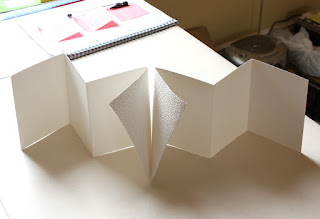

The end of June I went on an artist's book making course which was brilliant, something I have wanted to do for a long while but never been in the right place at the right time to do it. The artist leading the workshop was Sarah Morpeth and you can view her work at www.sarahmorpeth.com Whilst I may not necessarily want to make books per se, I very much like the idea behind paper folding and the subsequent subject of books, literature, text, language etc. Sculptural and architectural interludes. This course has directed me forward in my paper folding exercises that I started back in May.
Time is moving forward has I head toward my solo show in November and December this year and piercing my large roll of paper has begun again in ernest. I have set deadlines for what I need to achieve at each stage of preparation for the show. It has been a period of intense piercing both with the large roll of paper and other paper folding, new ideas.
Here's a snippet of what I have been thinking about whilst I work:
Why do I pin?
What am I doing?
What am I trying to say?
What are the folds?
Silent pinning
Musical pinning
Mending
What am I mending?
Opposite of mending?
Something to pick up and put down
Something physical and practical (to do)
Changing the structure
Chore
Burden
Release
Dusty
Guilt
Whilst these words suggest my physiological state, there are formal decisions to be made prior to the piercing of the paper and during the process of making.
Here are some extracts from my notes:
Different folds?
Straight or random holes?
Mass or 1 hole?
A box - No? Becomes a container
Size of hole in relation to size of paper
Layering
Structure
Fold
Balance
Weight
Relationship of fold line to hole
Different size holes?
Cluster (s)
Which way the holes showing (front or back)?
Which way pin - horizontal or vertical?
Spacing of holes in paper
Light and shadow
One thing that I am beginning to take on board and realize is that my work physically takes a long time to make. It is about challenging, and excepting that. The large roll of pierced paper will be the biggest artwork that I have ever made to date. This is a new experience for me. It is slow work. Enduring, but slow.
My right arm, hand and elbow are beginning to ache with all the piercing that I am doing and I need to take care that this doesn't become a problem, particularly long term. I need to think about alternate ways of making that take care of my limbs in between.
Some images of works in progress:


I like the contrast between smooth and rough, flat and bent, where the paper curls, changing the shape and form of the whole

I like where the holes buff up against the fold lines. There are pressure points, even more emphasized where two lines meet. The flatness of the paper has been interrupted by the fold lines and distorted even more with the addition of the holes.
There are so many variations to be tried with this work, a series. I would like to submit paper artworks to exhibitions but without framing them, and I'm not sure how to go about this? I like the idea of 'giving' a piece of paper to somebody (hopefully in exchange for money!), but without 'packaging' the work up in a frame or box for example. The paper is the work. I love the idea of a piece of paper which sits in a space, or hangs from a ceiling, but how do you hang a piece of paper on a wall with minimal visual attachments? Scale can be important too, from the large, to the very small.
Monday, 18 June 2012
Blog 28
This last month I have been to a crowdfunding workshop organized by Hi-Arts, a company that provides development and support to the arts and heritage industries in Scotland. As a recent newcomer to the area, it was a great opportunity to meet other creatives.
Crowdfunding is an up and coming way of raising funds for your projects through the internet and social networking, inviting people to donate money from £1 to £1000, in return for rewards such as a publicized thank you, original artwork or edition of, or tutored workshop for example. I think it is a more personable way of raising cash to support and make your projects happen and an exciting alternative to the government led initiatives that are rapidly drying up.
In the studio I have been drawing maps of our journey in the van during these last two years. There is so much scope to be had with this subject and I wanted to create some visuals to set the ball rolling. There is discussion at the moment to publish a book for my show and give a background history about me.

Destination stops in Britain 2010 - work in progress
Preparations for my show are hotting up. I am collaborating with a film - maker to produce a film and sound piece about piercing paper and I have very recently linked up with an art historian who is going to write a text about my work. Photography for the publicity has been done and designs for the posters, invites, coverage etc will be put together in due course. Thank you to everyone who is working with me on this.
These last few days I have been doing a lot of writing, recapturing why I am doing what I am doing. Writing is a good thinking tool for me even if I disregard the work later on. I found myself going dizzy where I was concentrating so much, and it became just an enjoyment to feel the flow of the pen across the page and see the black ink flowing onto the paper.
Hi - Arts
http://hi-arts.co.uk/
Friday, 18 May 2012
Blog 27
I am still continuing my debate with the picture frame. Taking simple white A4 sheets of paper, I have been folding them, creating single or double seam lines, in series. Held up vertically, they look like screens. I imagine them door size, even bigger. They look like openings to something behind? I've been piercing the paper with holes at different points, but I'm not sure what the relationship between the holes and the seams are, perhaps none.
I've employed a reading strategy that encompasses my practice and personal interests. It has been such a pleasure picking up books again. I've just read 'From the Mull to the Cape. A gentle bike ride on the edge of wilderness' by Richard Guise, a guy who took a 586 mile bike ride through the Highlands of Scotland.
I'm just finishing 'The Cloudspotter's Guide' by Gavin Pretor-Pinney. Like the wonderment of our sky at night and the stars and moon etc., I'm not interested in being able to name all the different constellations and cloud formations, but more to think about a spatial atmosphere that exists around us.
Clouds are made up of millions of water droplets, at various different sizes. The water droplets within the clouds and air suck up pollutants to 're clean' it, at least try. This activity is going on all around us, but you can't actually see it.
Pretor-Pinney writes about the sensation of thick fog and it reminded me of a walk Shawn and I took up Scarfell Pike in Cumbria, the highest mountain in England, a few years ago. The fog came down and engulfed us. We were soaked with the moisture from the fog and disorientated with the lack of visibility. When we finally came out of the cloud, we found we were right on the edge of a high precipice, in a precarious position and far away from our finishing point. But it was this sense of being soaked and disorientated that I remember the most, and an all encompassing spatial awareness.
When I read I like to sit by a particular window in the bedroom. If you latch the window open you can hear the lapping of the waves and the sound of birds and the view is of the sky only. All very poetic. I've just cut out a picture of 'The Deer Shelter' by James Turrell at the Yorkshire Sculpture Park where he created a square in a ceiling opening up to the sky. I can see that my personal skylight is a bit like 'The Deer Shelter'.
I've noticed that when it rains and I hear the rain hitting the window-pane, sometimes in quite a fury, I feel myself almost waiting for the rain to hit my face, but it doesn't. There is this pregnant pause and then nothing. It is a weird sensation.
I have been recommended to draw some of my maps from our two year journey in our van, as part of my solo show. There is a lot to do and I've just started the process. It will be interesting how my drawings develop and how I respond to this work. There are lots of dots to plot and think about.
A couple of weeks ago, Shawn and I took a trip to Ardnamurchan, the most westerly point in the UK. We have now reached all four edge points of mainland Britain, North, South, East and West. We could see some of the other Hebridean islands in the distance and it's given me a bigger sense of my positioning where I live and I would love to visit these islands.
I've employed a reading strategy that encompasses my practice and personal interests. It has been such a pleasure picking up books again. I've just read 'From the Mull to the Cape. A gentle bike ride on the edge of wilderness' by Richard Guise, a guy who took a 586 mile bike ride through the Highlands of Scotland.
I'm just finishing 'The Cloudspotter's Guide' by Gavin Pretor-Pinney. Like the wonderment of our sky at night and the stars and moon etc., I'm not interested in being able to name all the different constellations and cloud formations, but more to think about a spatial atmosphere that exists around us.
Clouds are made up of millions of water droplets, at various different sizes. The water droplets within the clouds and air suck up pollutants to 're clean' it, at least try. This activity is going on all around us, but you can't actually see it.
Pretor-Pinney writes about the sensation of thick fog and it reminded me of a walk Shawn and I took up Scarfell Pike in Cumbria, the highest mountain in England, a few years ago. The fog came down and engulfed us. We were soaked with the moisture from the fog and disorientated with the lack of visibility. When we finally came out of the cloud, we found we were right on the edge of a high precipice, in a precarious position and far away from our finishing point. But it was this sense of being soaked and disorientated that I remember the most, and an all encompassing spatial awareness.
When I read I like to sit by a particular window in the bedroom. If you latch the window open you can hear the lapping of the waves and the sound of birds and the view is of the sky only. All very poetic. I've just cut out a picture of 'The Deer Shelter' by James Turrell at the Yorkshire Sculpture Park where he created a square in a ceiling opening up to the sky. I can see that my personal skylight is a bit like 'The Deer Shelter'.
I've noticed that when it rains and I hear the rain hitting the window-pane, sometimes in quite a fury, I feel myself almost waiting for the rain to hit my face, but it doesn't. There is this pregnant pause and then nothing. It is a weird sensation.
I have been recommended to draw some of my maps from our two year journey in our van, as part of my solo show. There is a lot to do and I've just started the process. It will be interesting how my drawings develop and how I respond to this work. There are lots of dots to plot and think about.
A couple of weeks ago, Shawn and I took a trip to Ardnamurchan, the most westerly point in the UK. We have now reached all four edge points of mainland Britain, North, South, East and West. We could see some of the other Hebridean islands in the distance and it's given me a bigger sense of my positioning where I live and I would love to visit these islands.
Subscribe to:
Posts (Atom)